A New Stage for Architecture and Immersive Storytelling
A programmable LED Exosphere, a 16K interior display and capacity for up to 20,000: the venue under construction on Yas Island between Yas Mall and SeaWorld Abu Dhabi.

Sign up to receive the latest tech news and updates from Property News International straight to your inbox.
By signing up, you will receive emails about property news products and you agree to our terms of use and privacy policy.
@2026 Property News International. All Rights Reserved.

A New Stage for Architecture and Immersive Storytelling
A programmable LED Exosphere, a 16K interior display and capacity for up to 20,000: the venue under construction on Yas Island between Yas Mall and SeaWorld Abu Dhabi.
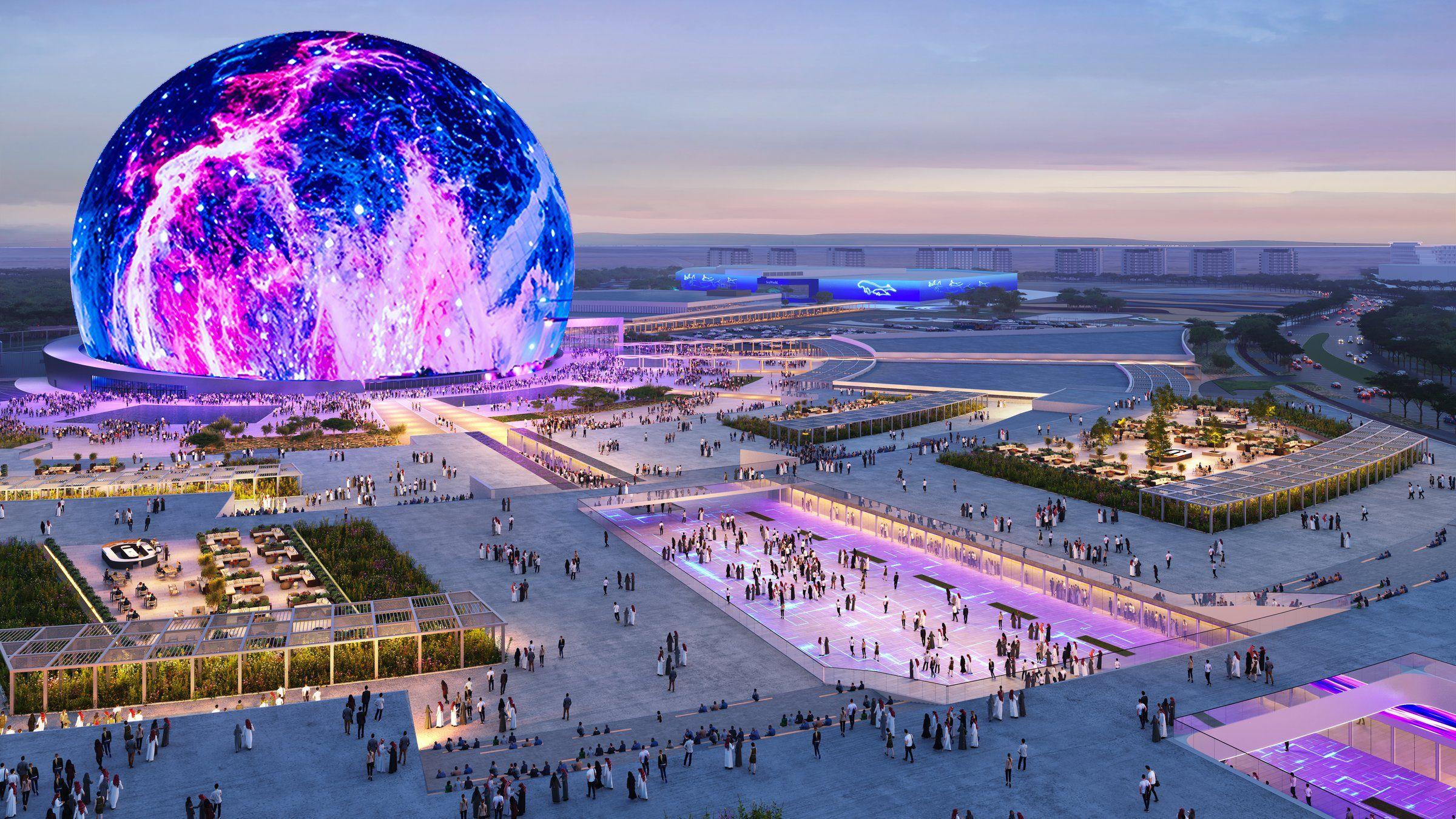 Aerial night view of Sphere Abu Dhabi on Yas Island
Lead Multidisciplinary Design and Supervision Consultant: AtkinsRéalis | Location: Yas Island, Abu Dhabi, UAE | Status: Under Construction; Construction Completion Targeted for End-2029
A building that changes its appearance with every programme asks something unusual of architecture. Its structure must provide the permanence, while its public face is designed to keep moving. That is the proposition behind Sphere Abu Dhabi, where a programmable exterior and an immersive auditorium will bring a different kind of landmark to Yas Island.
The project is being developed by the Department of Culture and Tourism – Abu Dhabi, with AtkinsRéalis appointed lead multidisciplinary design and supervision consultant and ALEC responsible for construction delivery. Announced in July 2026, the design-and-build partnership gives AtkinsRéalis overall coordination across architecture, structural engineering and the specialist technologies that will shape the audience experience. Here, the engineering of the enclosure and the production of images and sound are inseparable parts of the design brief.
The technical ambition is considerable. AtkinsRéalis describes a wraparound interior display capable of 16K visuals, supported by beamforming audio that can direct sound towards individual seats. Outside, the programmable LED Exosphere will give the venue a presence that extends beyond the performance taking place inside. The challenge is to make these systems work together as a coherent building, with the practical demands of audience movement and construction resolved alongside the spectacle.
Its setting will matter just as much as its equipment. The site lies between Yas Mall and SeaWorld Abu Dhabi, placing the venue within an established concentration of entertainment and hospitality. Rather than requiring visitors to make a separate journey to a remote cultural object, Sphere will become another destination within an island already organised around large-scale attractions. Landscape and the approach to the building will form part of that experience, preparing audiences for the shift from everyday surroundings to a digitally constructed environment.
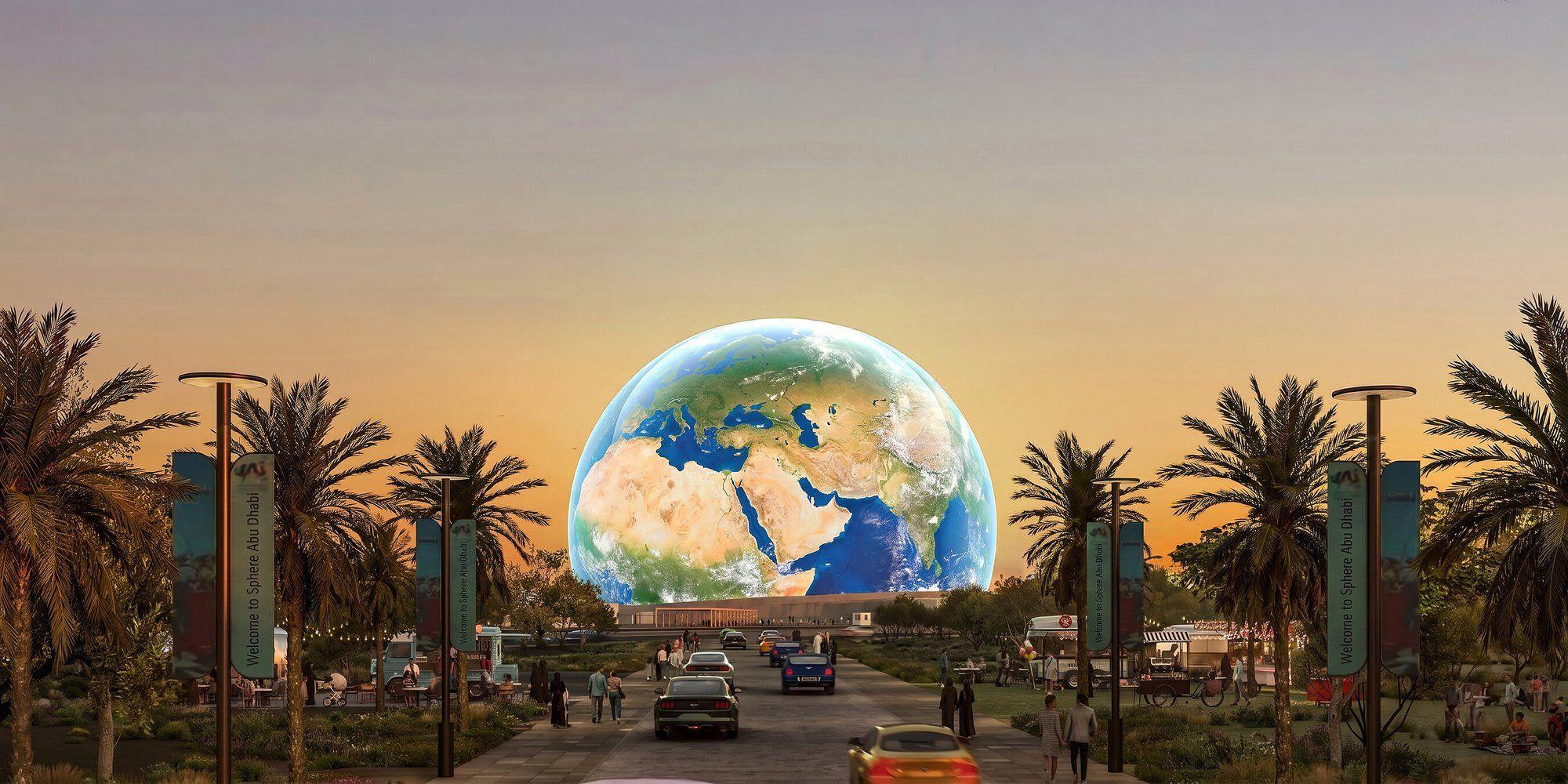 Sphere Abu Dhabi seen from the approach at sunset
Capacity is planned at up to 20,000, depending on configuration. The programme includes immersive productions, concert residencies and events ranging from sport to conferences. Plans for the exterior also include work by Emirati artists, giving the screen a potential role as a public exhibition surface. That cultural ambition is important: the building's identity will depend partly on what it shows, and on whose stories occupy its most visible face.
Sphere Abu Dhabi remains a project in delivery, not a completed attraction. In September 2026, ALEC chief executive Barry Lewis reported that piling and ground works were under way. The announced target is to complete construction by the end of 2029. Those milestones place the project firmly in the next chapter of the region's architecture, with its finished spatial qualities still to be experienced.
Lewis describes an approximately 150-metre-diameter structure with two envelopes: an inner enclosure for the amphitheatre and immersive screen, and an outer layer carrying the Exosphere. He also makes clear that Abu Dhabi requires its own engineering response to climate, regulations and infrastructure. The familiar spherical form therefore conceals a substantial task of local adaptation. For the design team, success means making that complexity disappear from the audience’s experience, leaving the building and its technology to serve the performance.

Stay ahead with the latest updates, insights, and trends shaping the world of real estate globally.