Property News International

Subscribe to Our Newsletter

Sign up to receive the latest tech news and updates from Property News International straight to your inbox.

By signing up, you will receive emails about property news products and you agree to our terms of use and privacy policy.

@2026 Property News International. All Rights Reserved.

Blends Media
A Blends Media Group Production

Sanctuary of Truth rises 105 metres in hand-carved wood on Pattaya coast

Begun in 1981 by Lek Viriyaphan, Pattaya’s 105-metre Sanctuary of Truth is joined without nails, carved over every surface and still being built, with completion projected around 2050.
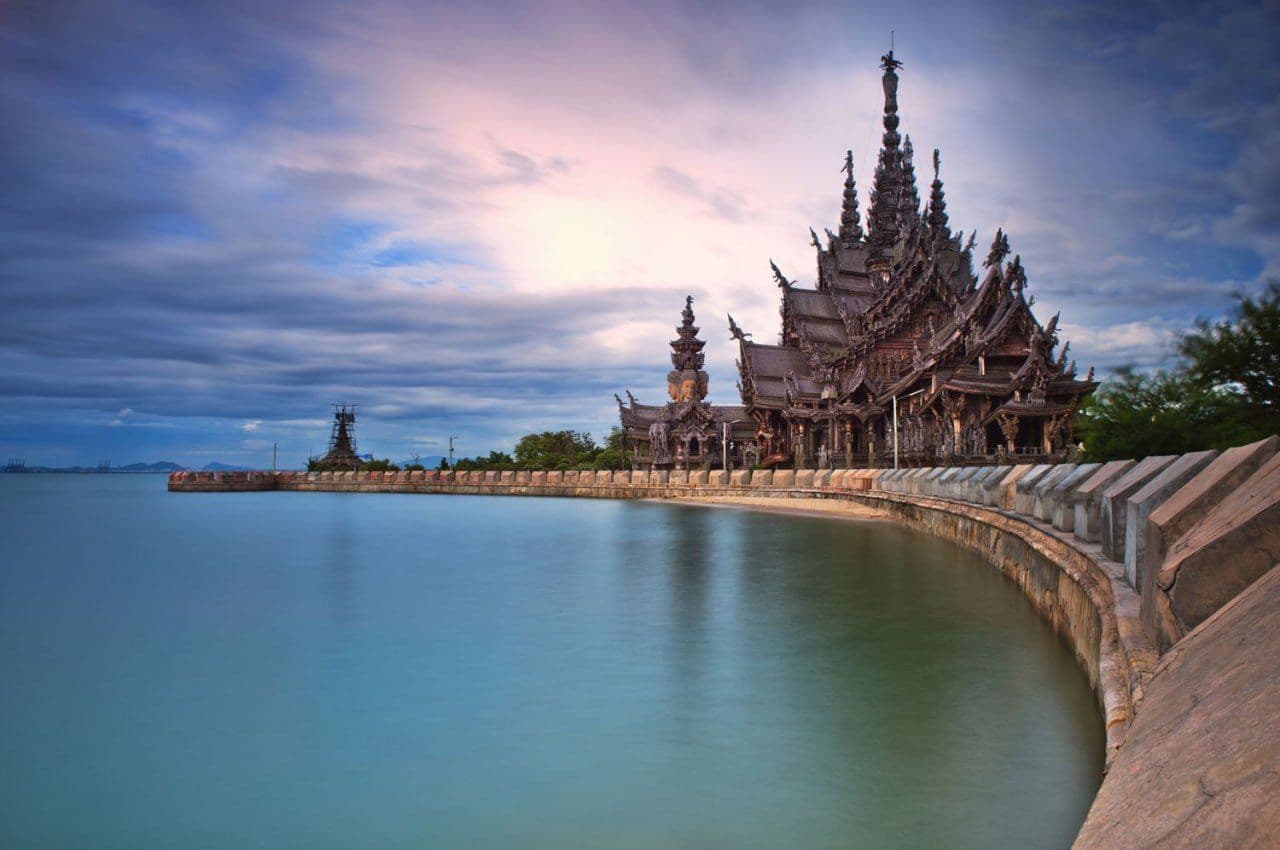
The Sanctuary of Truth seen across the water from the curved sea wall on the North Pattaya coastThe Sanctuary of Truth seen across the water from the curved sea wall on the North Pattaya coast.

Pattaya, Thailand - The Sanctuary of Truth, a 105-metre timber structure on the North Pattaya shoreline, has been under construction for more than four decades, with carvers still adding hand-cut sculptures to a building that uses no nails at all.

Work started in 1981 and the site remains a working one. Most tourists turn up expecting another busy temple photo stop and leave lost for words, and it calls the building unlike anything else in Southeast Asia.

A founder’s project, begun in his sixties

The sanctuary was the idea of Lek Viriyaphan, a Thai-Chinese businessman born in 1914 in Bangkok’s Sampeng district. A self-made industrialist who put his fortune into preserving culture rather than into luxury.

Before Pattaya, he had created Ancient Siam (Muang Boran) and the Erawan Museum in Bangkok, two large-scale efforts to record and celebrate Thai heritage. The museum’s founder page says he worked with the support of his wife, Praphai Viriyaphan, and that the family spent over 10 years studying and surveying sites across Thailand with academics.

Building began in 1981, when he was already well past 60. His aim was a structure that gave physical form to ancient Eastern philosophy, with the teachings of Buddhism and Hinduism told through carved timber instead of written text.

Lek Viriyaphan died in November 2000, well before the sanctuary reached its present size. His family and the foundation he set up have carried the work on since.

The project is not tied to any one faith. Its purpose is to remind people of values common to all the ancient traditions: the search for truth, the significance of the cosmos and the links between every living thing.

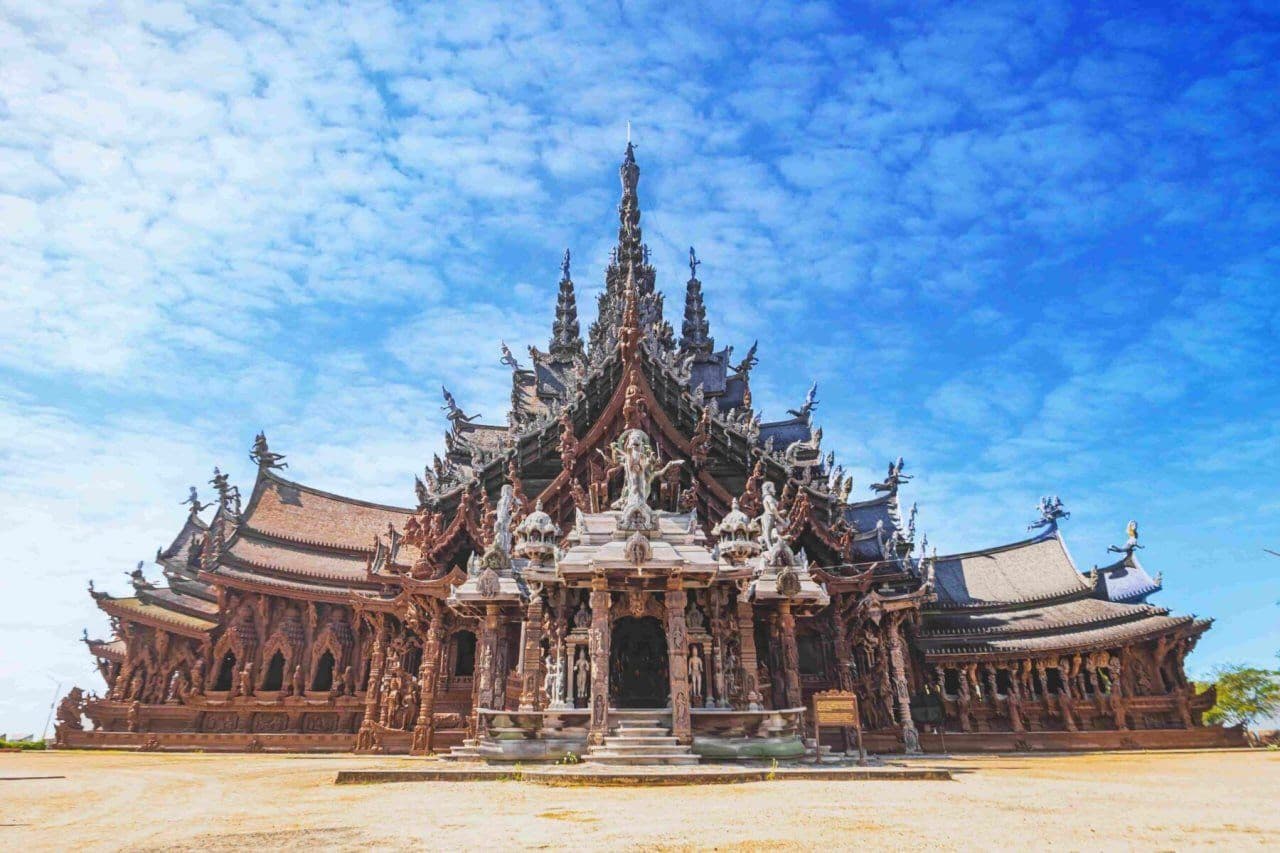
The main facade and carved spires of the Sanctuary of Truth, a timber building joined without nailsThe main facade and carved spires of the Sanctuary of Truth, a timber building joined without nails.

105 metres of timber, joined without nails

Known locally as Prasat Sut Ja-Tum, the sanctuary reaches 105 metres, which places it among the largest wooden buildings in the world. The Sanctuary of Truth Museum describes itself as the largest wooden castle in the world.

Building is made entirely of wood, from teak and other tropical hardwoods, and that not one nail is used anywhere in it. Every piece is held by traditional joinery, a genuine feat of architecture.

Wikipedia’s entry on the sanctuary names four timbers: Mai Deang, Mai Takien, Mai Panchaat and teak. Takien, the oldest wood in the structure, was used for the main post and is expected to last 600 years.

The same entry puts the indoor space at 2,115 sq m on a 13-hectare site, and describes the building as a hybrid of temple and castle themed on the Ayutthaya Kingdom and on Hindu and Buddhist beliefs.

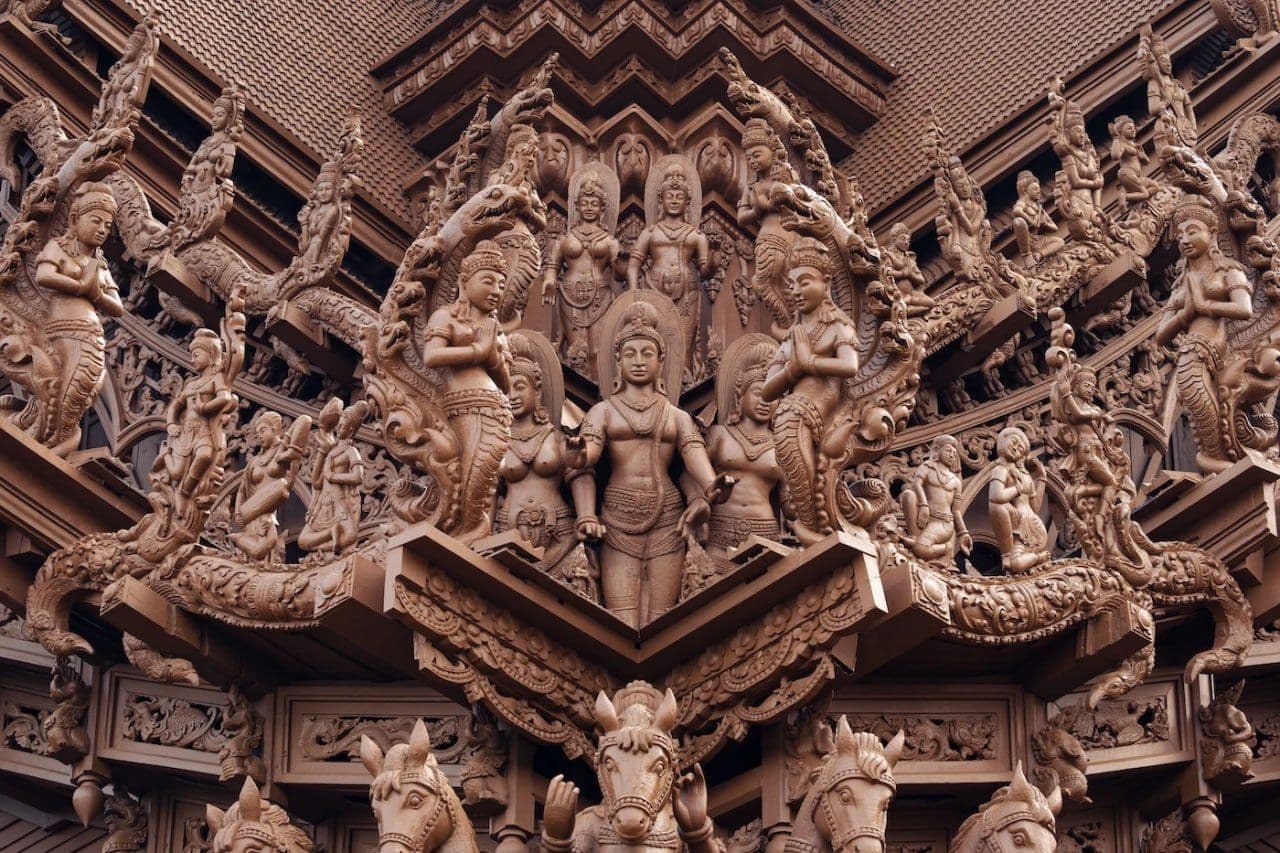
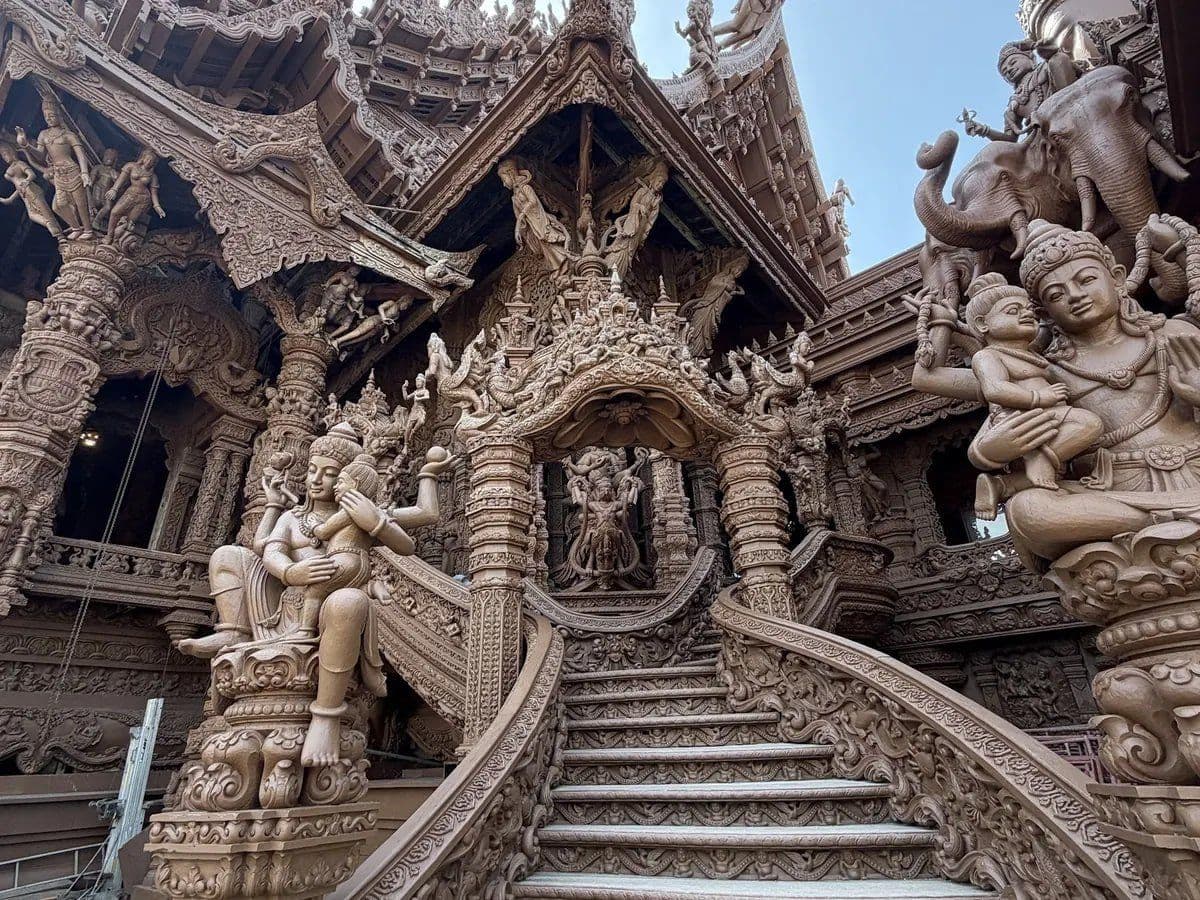
Every surface, beam and arch carries hand-carved figures: gods, mythical creatures, elephants, celestial beings and scenes taken from Hindu and Buddhist stories. The Tourism Authority of Thailand has described supporting columns made from teak trunks, and carvings that range from a huge three-headed Erawan elephant at the entrance to finger-sized Bodhisattvas.

Artisans work on the building every day. Completion is projected for around 2050, since the unfinished state is the purpose of the project.

Four sections, seven creators

Inside, the sanctuary is split into four main sections. Each faces a compass direction and carries a philosophical theme drawn from a different Asian tradition: Thai, Khmer, Chinese and Indian. Walked in order, they tell one connected story across those cultures.

Figures throughout the building stand for the seven creators of life, carved in wood as heaven, earth, moon, father, mother, sun and stars.

TAT has described the four halls meeting in a tall central atrium. The hall facing the sea symbolises the origin of life and the universe, the second celebrates the sun and moon, the third honours parental love and the fourth promotes humility, sacrifice and goodness.

Carved deities, serpents and horses crowd a roof corner of the Sanctuary of TruthCarved deities, serpents and horses crowd a roof corner of the Sanctuary of Truth.

Carving on every surface

No part of the interior is left plain. Walls, columns and ceiling panels are carved down to the last centimetre, photographs fail to show how densely the imagery is packed.

Visitors find deities with many arms, scenes of the cosmos being created, coiled and intertwined serpents, and human figures shown praying or fighting. The carving style changes from one section to the next, following the visual language of each tradition.

Unlike a standard museum, the sanctuary still has its carvers on site. On most mornings craftspeople can be seen cutting new panels, sanding finished sections or fitting carved pieces into the frame overhead.

It's a craft tradition that is still alive, rather than an exhibit behind a rope. The museum says its pieces are made by Thai and Burmese sculptors working with hammer and chisel, in a carving area to the south of the main building.

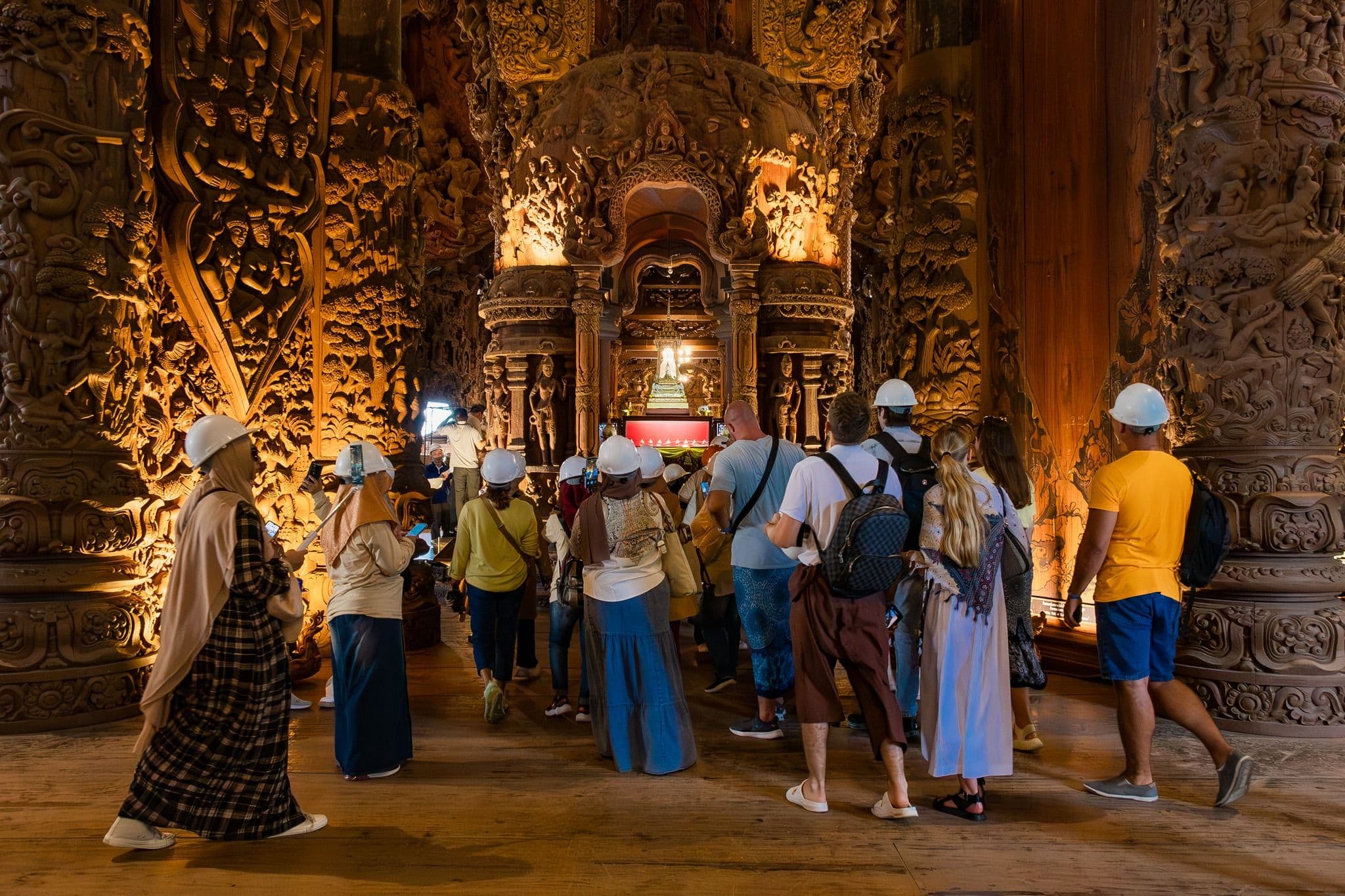
Visitors in hard hats walk through a carved interior hall of the Sanctuary of TruthVisitors in hard hats walk through a carved interior hall of the Sanctuary of Truth, where helmets are compulsory.

The sanctuary stands on a cape looking out to sea, at Laem Ratchawet in Na Kluea, according to the museum. Its grounds take in gardens, viewpoints and a small zoo where visitors can get close to animals.

The coastal setting brings a sea breeze even in hot weather, and the view of the building from the water’s edge is the picture most visitors take home. Seeing all of the grounds takes 1.5 to 3 hours, depending on pace and on how long people spend with the carvings. Public transport is possible but needs planning.

A carved wooden staircase flanked by figures holding children leads into the Sanctuary of TruthA carved wooden staircase flanked by figures holding children leads into the Sanctuary of Truth.

Shows, boats and a carving workshop

The guided tour is the centre of the visit, but there is more to do on site. Traditional Thai dances and bamboo stick performances are staged at set times through the day. The schedule is posted at the ticket counter and can change.

Outside the main building, speedboats circle the cape to show the sanctuary from the sea. Paid extras include an ancient dredger viewpoint, elephant rides and carriage rides. The museum says its ancient dredgers are boats made from a single large tree, each more than 100 years old, rowed by oarsmen with over 30 years of experience.

At a wood-carving workshop, visitors can try basic carving with guidance from the resident craftspeople, for anyone interested in how the building is made.

Other facilities include a mini zoo where animals can be fed, a foot massage area, a photo gallery, traditional Thai instrumental music and a gift shop selling locally made carvings and souvenirs. Naklua Kitchen, the on-site restaurant, serves Thai food, and a Snow Forest photo area offers an unexpected contrast with the tropical setting.

When to go and how long to stay

November to February are the best months for Pattaya overall. They are cooler and drier, early-morning crowds are manageable, and the late-afternoon light falls well on the timber exterior.

March and October are reasonable shoulder months, with slightly fewer visitors in exchange for more heat or more rain.

Within the day, arriving by 9:00 AM, when the building is quiet and the carvers are starting work, or after 3:00 PM, once the midday crowds have thinned and the temperature has dropped.

The hours from 10:00 AM to 2:00 PM are best avoided. Tour buses arrive in numbers then, and the tropical heat inside the open timber structure becomes hard to bear.

Most visits last 1.5 to 3 hours. The guided tour, a dance show, the grounds and one extra activity together take close to 3 hours, while a quick walk through with only the tour takes less than 90 minutes. Slower visitors are rewarded, as the carvings keep revealing new detail on a third pass.

Visitors explore the richly carved wooden interior of the Sanctuary of Truth in Pattaya.Visitors explore the richly carved wooden interior of the Sanctuary of Truth in Pattaya.

A museum, not a temple

The sanctuary is officially classed as a museum, while working as both a cultural monument and an ongoing art project. It is not a place of active worship in the way a functioning temple is, though its carvings draw heavily on Buddhist and Hindu iconography, and visitors of every faith are welcome.

Children are admitted at a reduced price, and hard hats come in smaller sizes. For families covers the heat, with water and hats for children, the uneven ground in places and the patience a slow walk through the interior asks of very young visitors. The animal feeding area and the outdoor grounds usually hold their interest.

The tour moves through the principal sections and explains what the key carved figures symbolise. Afterwards, visitors are free to go back to any section at their own pace or try the other activities.

In peak season, booking ahead secures a slot on a guided tour and avoids the morning queues at the gate. Outside that period, tickets bought on arrival are usually easy to get. Advance tickets are sold on the official Sanctuary of Truth website and through established booking platforms.

The building keeps growing because its founder meant it to reflect the idea that human wisdom and understanding are never complete. The 2050 date may itself move, and until then the carpenters and carvers at work remain one of the main reasons to visit.

Project details

Project: Sanctuary of Truth (Prasat Sut Ja-Tum)

Location: Naklua, Bang Lamung District, Chonburi, Thailand

Founder and designer: Lek Viriyaphan

Height: 105 metres

Indoor area: 2,115 sq m

Site: 13 hectares

Materials: Teak and other tropical hardwoods, joined without nails

Construction start: 1981

Projected completion: Around 2050