Manufacturing Becomes Largest Source of Demand
Manufacturing and industry emerged as the largest contributor to industrial demand in Dubai during H1 2026, accounting for 35.1% of all new requirements.
Logistics occupiers represented a further 15.5%, meaning the two sectors collectively accounted for around half of total demand.
Demand also shifted towards larger facilities during the first half of the year.
Warehouses measuring between 10,001 and 50,000 square feet accounted for 35.5% of requirements, while facilities between 50,001 and 100,000 square feet represented 32.2%. Demand for warehouses exceeding 100,000 square feet increased significantly, accounting for 27% of all requirements, compared with 7.8% during H2 2025.
Adam Wynne MRICS, Partner – Head of Commercial Agency, UAE, said:
"The 12.3 million sq ft of new requirements recorded during the first half of the year demonstrates that the market's underlying fundamentals remain strong. However, occupiers are becoming more selective, prioritising efficient, modern facilities in strategic locations while carefully assessing costs and the wider impact of regional disruption.
"The increase in requirements for facilities exceeding 100,000 sq ft also demonstrates that demand from major manufacturers and logistics operators remains resilient, underscoring the resilience and attractiveness of the UAE's base fundamentals for industrial and logistics operators, despite the ongoing regional hostilities."
Knight Frank said rental performance across Dubai became more mixed during H1 2026, with some locations continuing to record strong growth while others moderated from the peaks seen in late 2025.
Al Quoz remained Dubai's most expensive industrial location, with Grade A rents averaging $24.50 (AED90) per square foot, representing annual growth of 6%.
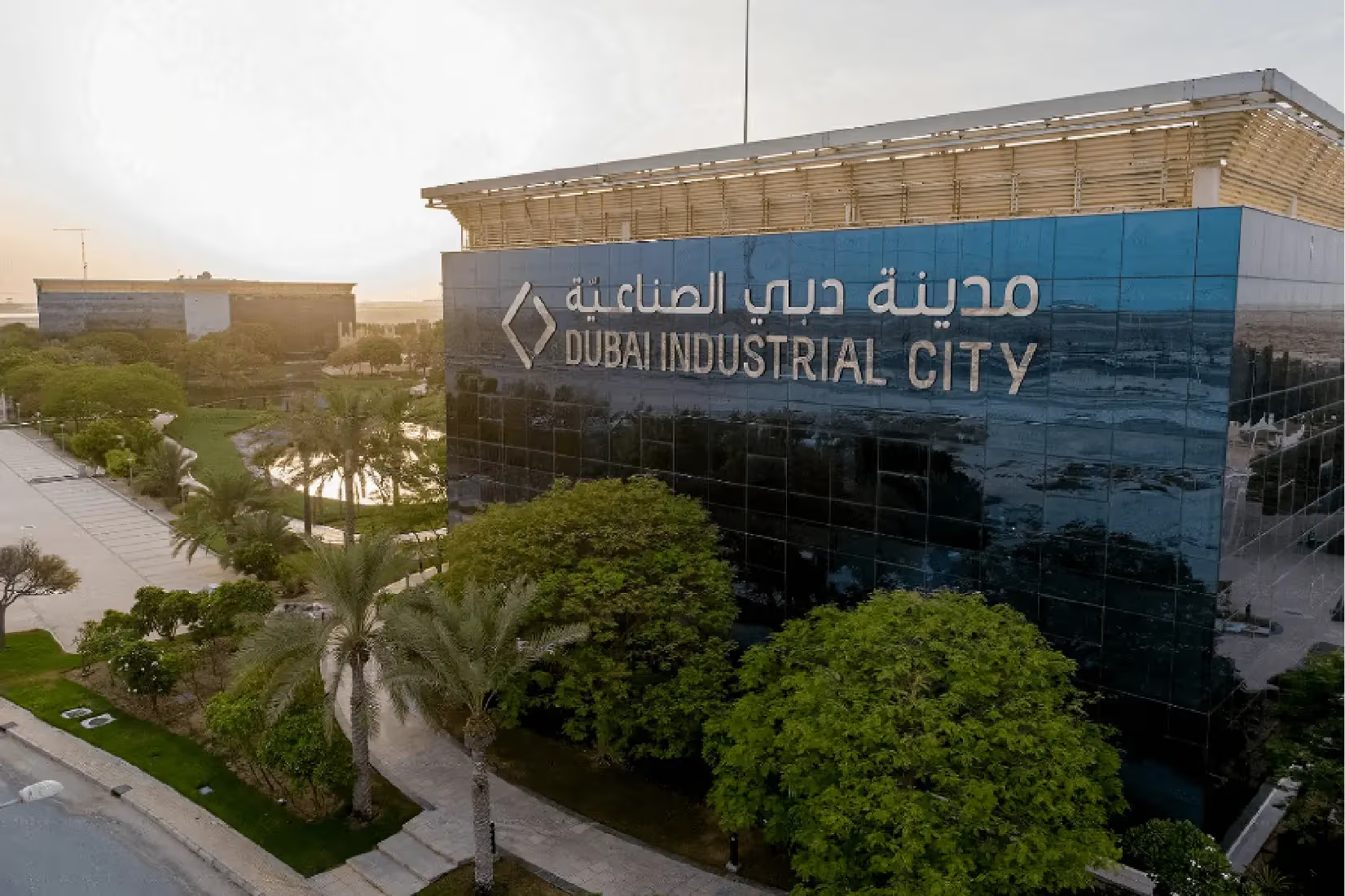
Dubai South recorded the strongest rental growth, with rents increasing 22% year-on-year to $14.98 (AED55) per square foot, while rents in Dubai Industrial City rose 16%.
In Abu Dhabi, KEZAD Mussafah (ICAD) remained the emirate's most expensive industrial and logistics submarket, with average rents increasing 15% year-on-year to $171.54 (AED630) per square metre. Rents in Al Markaz rose 7% to $108.92 (AED400) per square metre.
Knight Frank also identified more than 10 million square feet of marketed warehouse availability across the Northern Emirates.
Umm Al Thuoob in Umm Al Quwain accounted for 5.2 million square feet of available warehouse space, contributing to downward pressure on rents, which declined 18.5% over the past 12 months.
Businesses Reassess Supply Chains
The report noted that disruption to shipping through the Strait of Hormuz has prompted businesses to reassess supply chains and consider alternative ports and trade routes.
Some occupiers are increasingly utilising ports including Fujairah, Khor Fakkan and Salalah before transporting goods by road into Dubai and Abu Dhabi.
Demand for air freight has also increased, particularly among businesses transporting high-value or time-sensitive goods.
Supply Expected to Support Market Rebalancing
Knight Frank said Dubai's upcoming industrial and logistics supply remains concentrated in 2026, with completions expected to moderate significantly during 2027 and 2028.
Longer construction timelines and strong pre-leasing activity are also expected to limit the volume of immediately available Grade A warehouse space.
The consultancy expects industrial rents in Dubai to stabilise over the next 12 months, with prime rents potentially finding a floor during the second half of 2027, assuming the regional conflict concludes before then.
Maxim Talmatchi MRICS, Partner – Head of Industrial and Logistics, ME, concluded:
"Beneath the monthly swings, the demand-supply imbalance that has defined the sector since 2021 is starting to correct. Newly completed stock is giving occupiers real choice for the first time in three years. More sellers are coming to market and rental data is pointing to a broad-based moderation in headline lease rates for the first time in this cycle. This means tenants are now very much in the driving seat a position they have not enjoyed since 2021.
"Abu Dhabi, we believe will see rents firming, supporting by near full-occupancy in key locations and land take-up underpinned by real, rather than speculative, demand. The Northern Emirates will trade on value, with Umm Al Quwain consolidating its cost play, while landlords in Sharjah and Ajman may find terms tested as Dubai's improved availability curbs the recent 'northern-bound demand'."