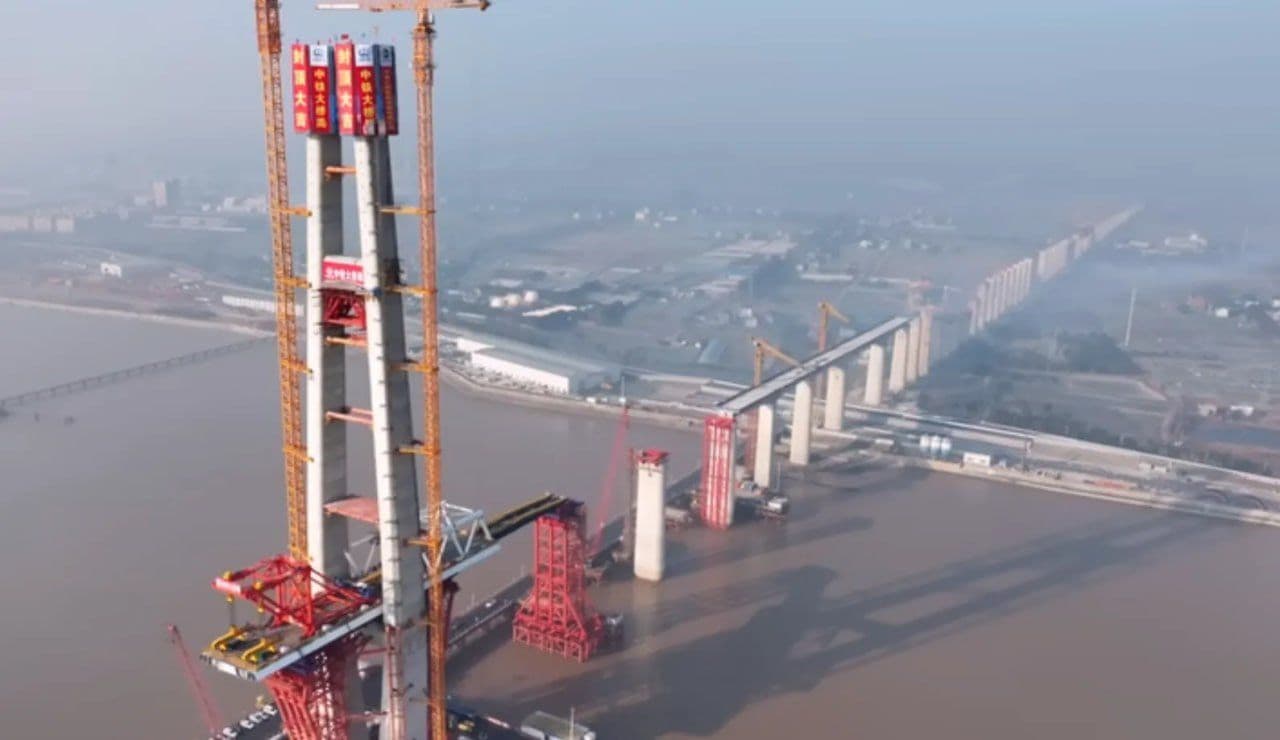
Haiyan, China - Crews on the Hangzhou Bay Cross-Sea Railway Bridge in Zhejiang province completed the final weld on its north channel span on 20 October, closing a key gap on a structure expected to become the longest cross-sea railway bridge in the world.
The work took place 570 metres off the coast of Haiyan county, where the last piece of the central closure segment was welded into place. With it, building the bridge’s main structure has moved into its final phase, China Daily reported.
Luo Yunfeng, Project Commander with Shanghai State Railway Engineering Construction Management Co Ltd, said: “Overall progress on the Hangzhou Bay Cross-Sea Railway Bridge has now exceeded 90 percent. We’re transitioning rapidly from large-scale structural work to the final stages, completing the main structure and installing the bridge deck system.”
Two tracks run across the 29.2km bridge, which forms a key section of the Nantong-Ningbo high-speed railway and is designed for trains running at up to 350km/h.
It links Haiyan county, part of Jiaxing in Zhejiang province, with Cixi, a county-level city under Ningbo’s administration, and sits upstream of the existing Hangzhou Bay highway bridge.
The crossing is made up of north, central and south main channel bridges, plus approach bridges over both shallow and deep water.
At the north channel, the cable-stayed bridge has a 450-metre main span. Luo said no high-speed railway bridge with ballastless track now being built anywhere in the world has a longer span.
That section runs to 932.7 metres and uses a hybrid steel box-truss girder, pairing a steel box girder on the lower level with steel trusses above it.
Wang Yinfeng, Deputy Project Manager with China Railway Major Bridge Engineering Group Co Ltd, said: “A 450-meter span represents an entirely new technical challenge. The core difficulty lies in controlling deformation of such a long, flexible structure within the millimeter-level precision required by high-speed track systems.”
Building in Hangzhou Bay means dealing with strong tides, fast currents and high winds. According to Wang, the comparatively shallow water at the north channel also meant crews had to time each steel girder lift carefully to the tides while working against strong currents.
To keep the sections lined up precisely at closure, the project teams relied on integrated bridge-track alignment control technology, intelligent data collection and continuous real-time monitoring through both manufacturing and assembly.
The Nantong-Ningbo line is a key part of the “eight vertical and eight horizontal” grid that makes up China’s high-speed rail network. It will have 11 stations and connect with several existing railway lines.
Luo said: “Once operational, the railway will bring rail service to Haiyan for the first time and high-speed rail to Cixi. The bridge will enable trains to cross directly over the sea, strengthening the integrated transportation network across the Yangtze River Delta region.”
Closure of the south channel bridge came on 17 October, and the central channel bridge is due to close by late November. Now that the north span is joined, work moves on to fitting bridge deck accessories and laying the ballastless track.