Property News International

Subscribe to Our Newsletter

Sign up to receive the latest tech news and updates from Property News International straight to your inbox.

By signing up, you will receive emails about property news products and you agree to our terms of use and privacy policy.

@2026 Property News International. All Rights Reserved.

Blends Media
A Blends Media Group Production

ADNOC Announces $16.3bn UAE Manufacturing Pipeline

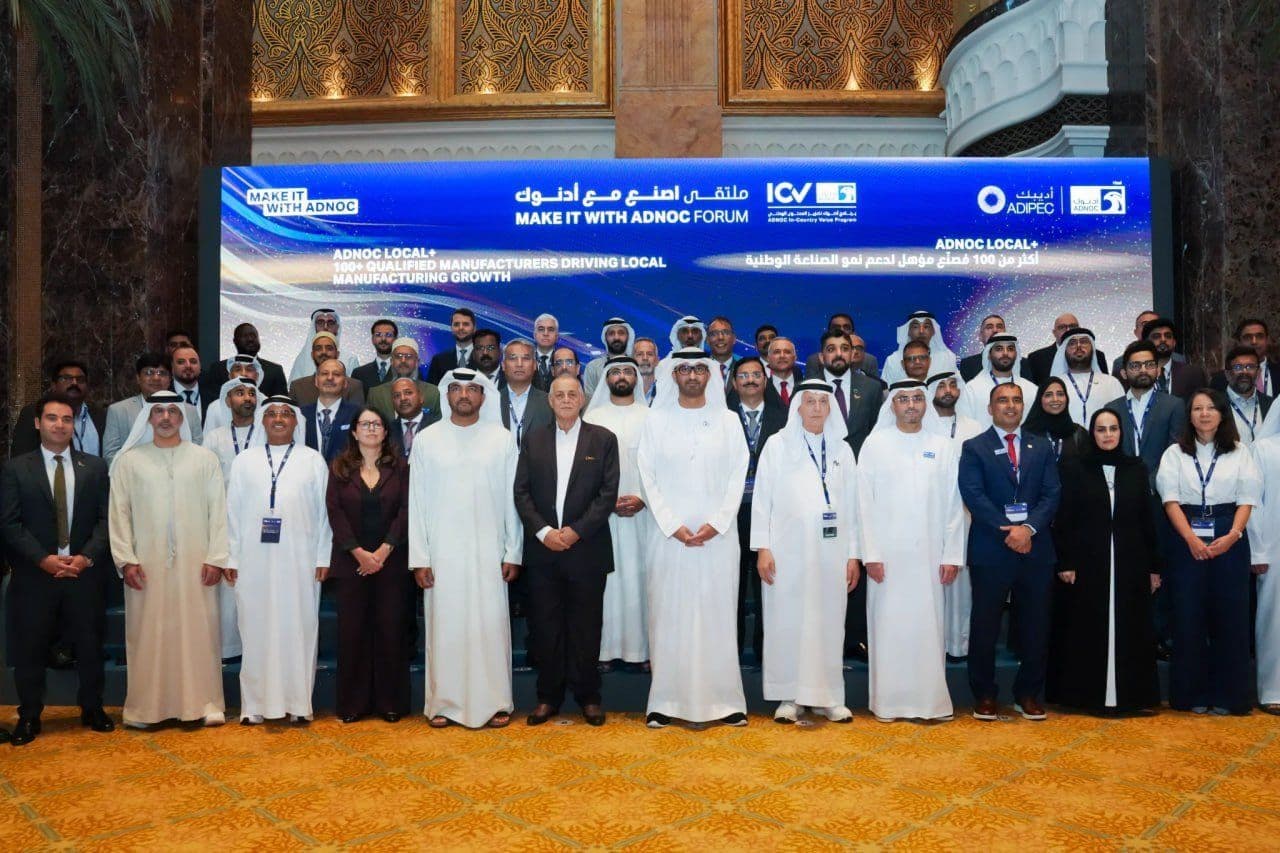
Attendees in front of an ADNOC Local+ screen marking more than 100 qualified manufacturers at the second Make it with ADNOC Forum in Abu DhabiAttendees in front of an ADNOC Local+ screen marking more than 100 qualified manufacturers at the second Make it with ADNOC Forum in Abu Dhabi (Image source: ADNOC)

Abu Dhabi, UAE - The Abu Dhabi National Oil Company (ADNOC) has put more than $16.3 billion (AED 60 billion) of local manufacturing work on the table to 2030, spanning over 200 essential products and critical spare parts that it wants made inside the UAE.

The company presented the pipeline at the second Make it with ADNOC Forum, staged at Emirates Palace in Abu Dhabi in the run-up to ADIPEC. ADNOC said the programme is meant to speed up local manufacturing, draw in industrial investment, create skilled jobs and bring more UAE-based manufacturers and suppliers into its projects and operations, while strengthening the country's industrial capabilities and the resilience of its supply chain.

Six groups of products are covered. They range from rotating equipment, power systems and drilling and completion equipment to electrical, control and automation systems, chemicals and catalysts, and piping, fabrication and heavy equipment, along with critical spare parts and advanced manufacturing.

Much of that list is imported today, which leaves room for manufacturers to set up or enlarge production lines in the country. According to ADNOC, making the items locally would cut supply lead times, lower its exposure to disruption in global supply and make its operations more resilient.

At the same forum, the company set out a wholesale overhaul of how it handles procurement, supplier registration, prequalification and In-Country Value (ICV), with the stated aim of making it easier for manufacturers, suppliers and investors to win its business.

Under the new registration and prequalification process, ADNOC is aiming to cut by up to 80% the time it takes a supplier to become eligible to bid. The number of documents a supplier must file will be halved, and prequalification will no longer be needed in 60% of service categories, according to the forum announcement. In its own release, ADNOC also said the procurement changes aim to shorten purchasing cycles by up to 40%.

Registration, qualification and compliance will sit together in one digital window, and what is asked of each supplier will depend on the type of work and how risky it is. Artificial intelligence will check documents and reuse data a company has already submitted, so firms make fewer repeat filings and less paperwork has to be processed.

Bids will also be judged differently. Commercial and ICV offers are to be scored together in a single evaluation model, which retires the bid-matching method ADNOC used before. The company said this should push suppliers to table their sharpest commercial and ICV offers from the start, and that requirements will be scaled to the size and scope of each contract.

Where ICV-related retention payments apply, they will be calculated and released automatically through the ADNOC Supplier Hub. ADNOC said this will make the process more transparent, reduce manual follow-up and help suppliers' cash flow as they meet their obligations.
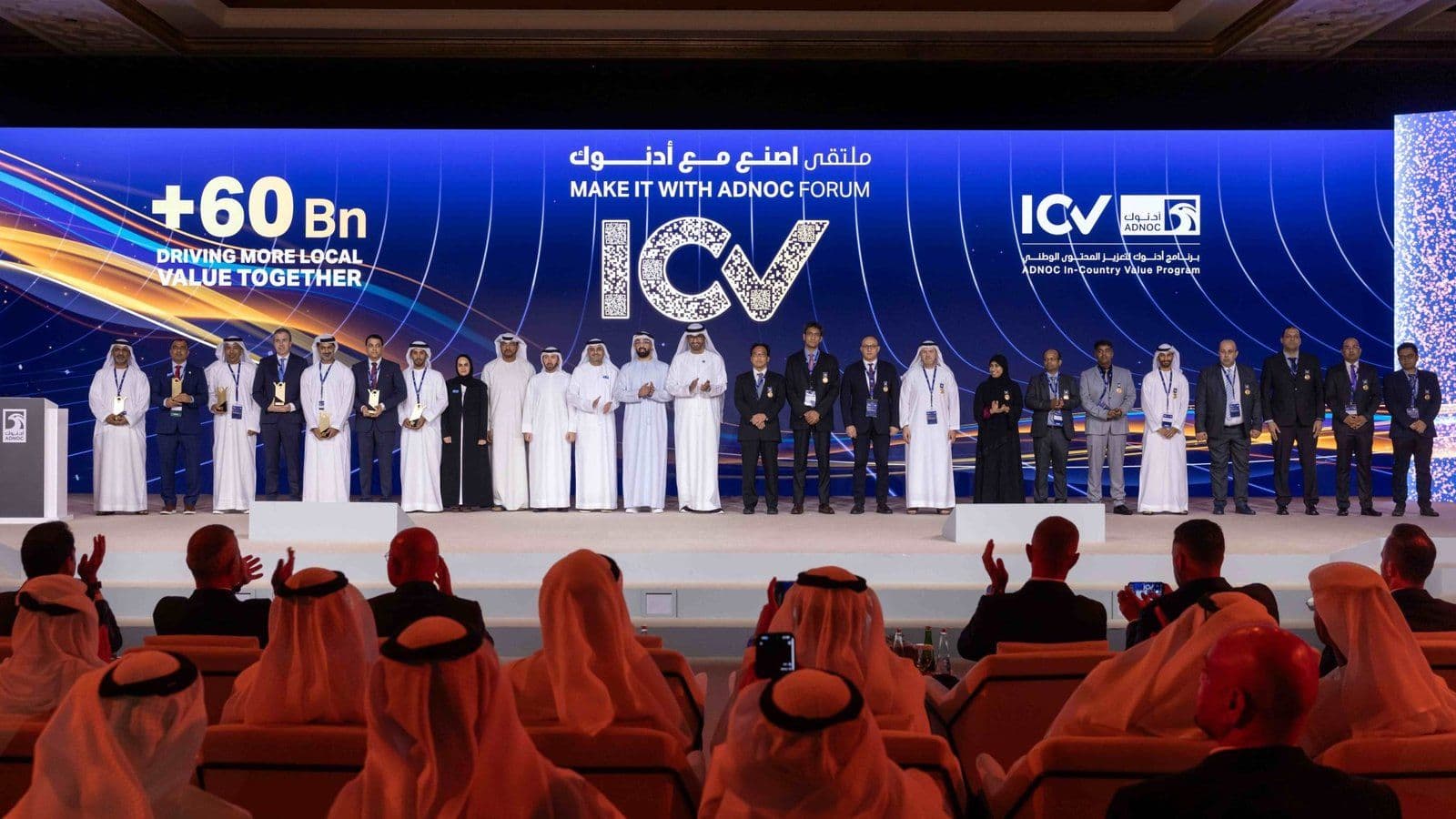
Honourees on stage at the Make it with ADNOC Forum at Emirates Palace, where the company marked eight years of its In-Country Value programmeHonourees on stage at the Make it with ADNOC Forum at Emirates Palace, where the company marked eight years of its In-Country Value programme (Image source: ADNOC)

To turn the identified demand into factories, ADNOC is working with the UAE Ministry of Industry and Advanced Technology (MoIAT) and the Abu Dhabi Investment Office (ADIO). The three will link the opportunities to national industrial support: visibility of ADNOC's demand, access to the national industrial database and finance from the National Industrial Resilience Fund. The company said the aim is to help manufacturers turn demand into viable industrial investments, in support of the objectives of ‘Make it in the Emirates’.

Two memoranda of understanding (MoUs) were signed on the sidelines of the event, one with ADIO and one with KEZAD Group, covering ADNOC's industrial development and local manufacturing goals.

Local+, the company's list of approved UAE manufacturers, now has more than 100 names, against 70 when it was launched in May 2026. Products from those manufacturers get priority on ADNOC projects, because engineering, procurement and construction (EPC) contractors taking part in new tenders must buy relevant items from firms on the list.

The ICV programme has also been given a refreshed identity. ADNOC said the new look reflects eight years in which the scheme has widened its remit to cover industrial development, investment and jobs as well as the competitiveness of its suppliers.

A new commercial approach rests on four shifts the company described as agile, competitive, strategic and forward-looking. In practice, ADNOC said, that means simpler procurement and quicker decisions, contracting models matched to project and market conditions, targeted commercial negotiations and earlier sight of its future demand for suppliers.

His Excellency Dr Sultan Ahmed Al Jaber, UAE Minister of Industry and Advanced Technology and ADNOC Managing Director and Group CEO, said: “ADNOC’s growth creates a powerful opportunity to deepen the UAE’s industrial strength. Our next phase is about giving manufacturers and investors the confidence to act: clarity on what we need, visibility of when we need it, and a simpler route to compete for our business. We are inviting companies to build capabilities in the UAE that will serve our industry and country for years to come.

“Every product we can competitively manufacture here strengthens our ability to deliver. The changes announced today connect that ambition to practical action, from faster supplier registration and more competitive procurement to long-term partnerships that support investment. We want our partners to grow with us, and we want that growth to create lasting value for the UAE.”

Omar Abdulla Alnuaimi, ADNOC Group Chief, Commercial and In-Country Value, said: “Over the past eight years, ADNOC’s ICV program has converted our demand into lasting value for the UAE, enabling products previously imported to be manufactured locally and strengthening the capabilities of our suppliers and industrial partners. The next chapter is about making the entire journey clearer, simpler and more competitive. We are giving the market earlier visibility of demand, expanding access to opportunities and rewarding companies that invest, localize and deliver measurable value in the UAE.”

The forum doubled as the eighth anniversary of the ICV programme, which ADNOC started in 2018 to steer more of its procurement spending into the UAE economy. It used the occasion to launch the ADNOC ICV Excellence Awards, honouring selected companies for local manufacturing, Emiratisation and supplier development, and naming ADNOC employees as ICV Champions for their part in building the programme.

Resilience partners were commended too. ADNOC said these companies answered urgent requests during recent disruptions, supplied critical materials and services, and helped keep its operations running.

ADNOC presents the $16.3 billion pipeline as one strand of a plan, running to 2030, to channel its growth and buying needs into lasting industrial investment, home-grown production capacity and firmer supply chains within the UAE.

By the end of 2025, the ICV programme had redirected more than $83.6 billion (AED 307 billion) into the UAE economy, according to the company. It has also supported the localisation of more than 130 products and the development of 95 UAE factories, and created employment opportunities for more than 27,500 Emiratis at participating private-sector companies.