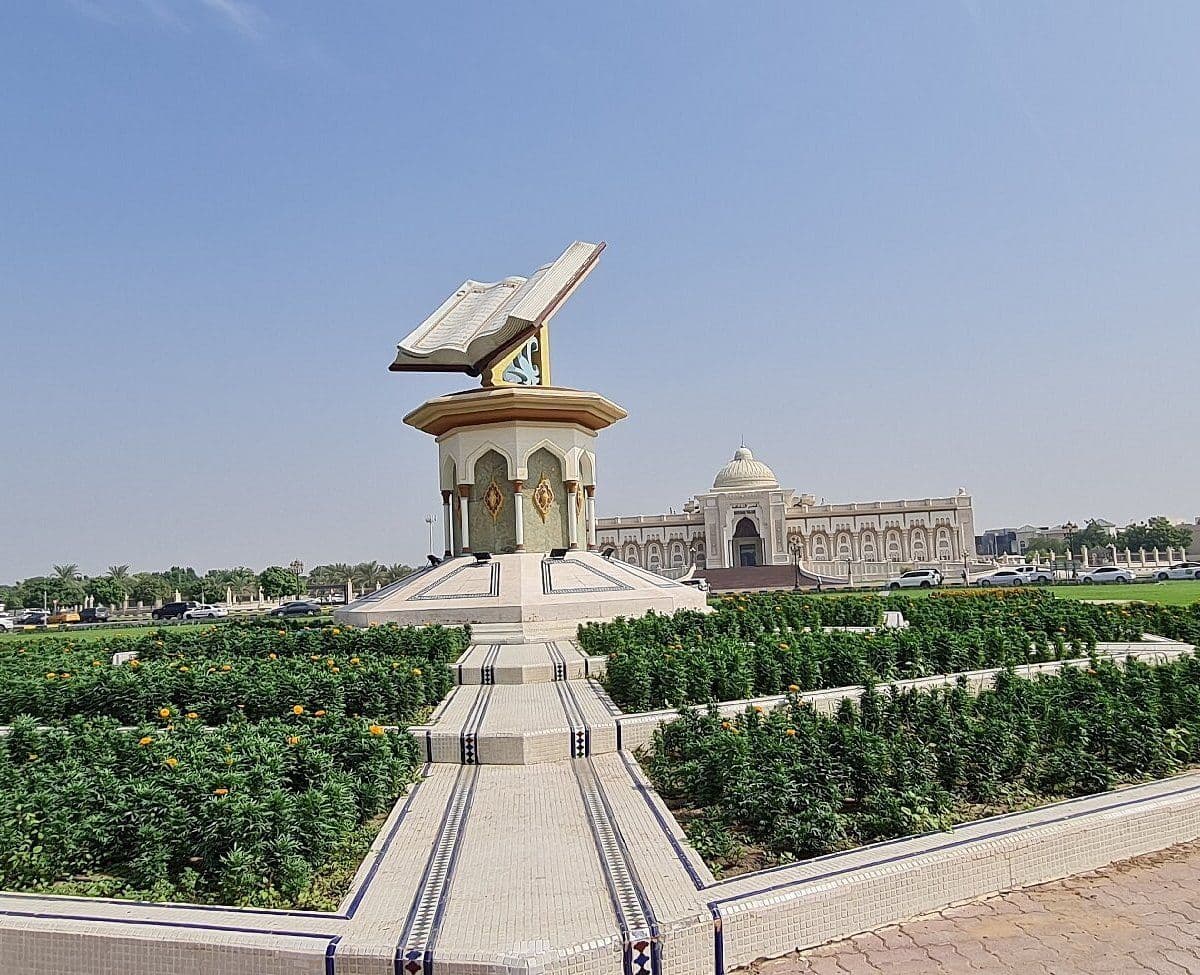
Sharjah, UAE - Sharjah is building an underground pedestrian tunnel to connect Imam Ahmad bin Hanbal Mosque with the area around the Holy Quran monument at Cultural Square, giving worshippers and visitors a safer way to cross the busy site.
His Highness Sheikh Dr Sultan bin Mohammed Al Qasimi, Supreme Council Member and Ruler of Sharjah, announced the project during a telephone interview on the Sharjah Broadcasting Authority’s Direct Line programme on Tuesday, October 20.
The project aims to stop pedestrians putting themselves at risk while protecting the square’s flowers and landscaping.
Contractor already on site
Sheikh Sultan said many people cross Cultural Square from the direction of the mosque, exposing themselves to danger and sometimes damaging the plants and flowers as they walk through the landscaped area.
The underground passage will give pedestrians a dedicated route. Starting from the mosque’s side, the tunnel will lead to a concrete walkway extending towards the Holy Quran monument, which has a circular path around it.
The contractor is already working at the site to complete the project, Sheikh Sultan said. Once finished, the route will let people reach the monument, walk around it and take photographs safely without disrupting traffic or damaging the surrounding greenery.
The Ruler said the square gives prominence to the Holy Quran because it is the guiding reference and constitution of Muslims. He said Cultural Square could also correctly be called Quran Square or Book Square, as the Holy Quran is the Noble Book of God.
Learning columns in Sharjah’s gardens
Sheikh Sultan also described Sharjah’s efforts to make public spaces centres of learning, particularly for younger generations.
Columns in the Islamic Garden and Arab Garden, extending towards the House of Wisdom, carry the names and stories of prominent thinkers. The Islamic Garden presents Islamic thinkers, while the section towards the Arab Capital of Culture features Arab intellectuals, including both Muslims and non-Muslims.
The Ruler has named the columns “Teaches and Learns”. Their short accounts of notable figures and their contributions are meant to help families explore cultural heritage together, with parents able to explain the stories to their children in a few minutes.
He said gaining knowledge requires intellectual and physical effort, commitment and diligence rather than financial resources, and encouraged younger generations to study their heritage and develop their understanding of religion, history and culture.
Publishing programme for the Sharjah International Book Fair
The announcement came alongside details of Sharjah’s publishing programme ahead of the 45th Sharjah International Book Fair, which opens at Expo Centre Sharjah on November 4.
Sheikh Sultan said the second part of the Comprehensive Arabic Encyclopaedia would be presented at the fair. The project is being developed over four years, with the goal of producing 500 volumes covering a broad range of disciplines.
The first part comprised 46 volumes completed last year, covering science, literature, the arts and notable figures. With the latest work, the total number of completed volumes will reach 130. The third part is scheduled for next year, followed by the final part in the fourth year.
The encyclopaedia is intended to make research more accessible by bringing together material across different fields. Readers researching prominent figures, for example, will be able to explore critical assessments and access relevant books through the collection.
The research team has grown from around 1,000 contributors to 1,300, following the addition of 300 researchers this year. Their work covers religious sciences, Arabic, literature and the arts, including theatre, novels, photography and painting.
The fair will also feature a 60-volume collection documenting Portuguese history across the Indian Ocean, from Mozambique to Indonesia. Sheikh Sultan said the historical documents had taken a year to review, with the final examination completed shortly before his interview.
An additional 61st volume will explain difficult terms and identify kings and ministers mentioned in the collection. The series will be published in Arabic and English.
Another publication, Majma’ al-Tawarikh, examines historical relations involving the British, Dutch and Ottomans. Sharjah is also preparing a book documenting the British presence in the Gulf from 1806 until their departure, drawing on original records including a handwritten plan attributed to British diplomat and military figure John Malcolm.
Sheikh Sultan said he hoped to complete the new book during the current year.