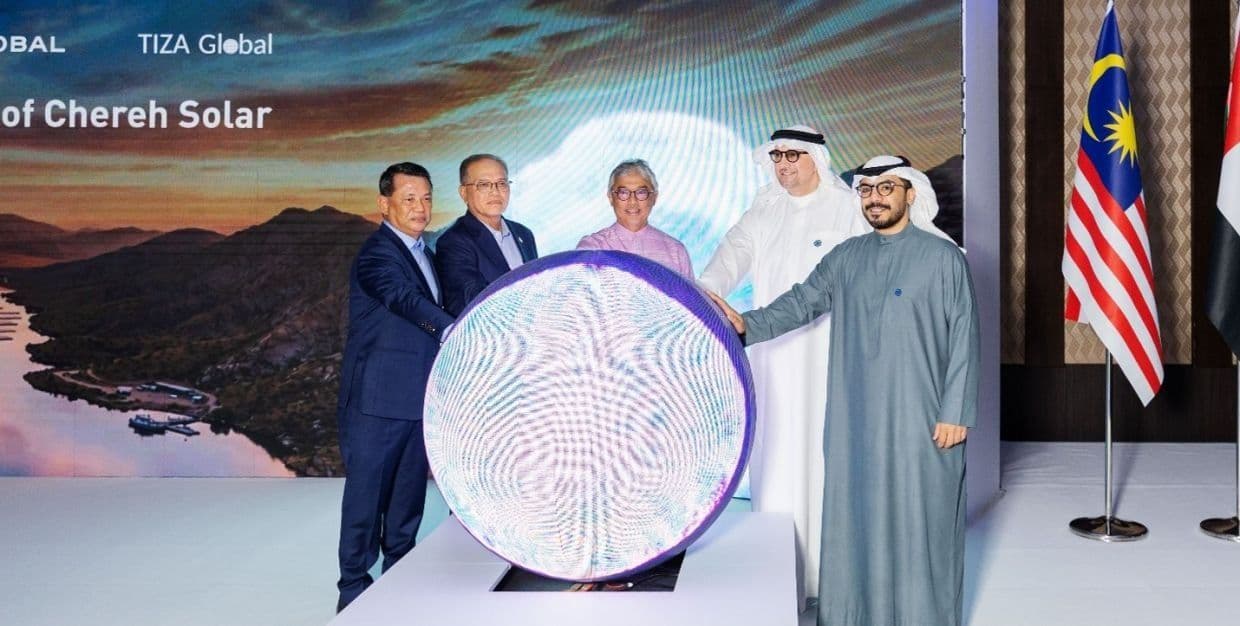
Pahang, Malaysia - Work has begun on the 200-megawatt Chereh Dam floating solar plant in Pahang, the first Malaysian project for Abu Dhabi’s Masdar, which is building it with local partners Citaglobal Berhad and TIZA Global Sdn Bhd.
The three companies held a groundbreaking ceremony to mark the start of construction. Their joint venture, Chereh Solar Sdn Bhd, is the developer, and the plant is due to begin operating in 2028.
Masdar said Chereh ranks among the biggest floating solar schemes in Southeast Asia and should produce enough clean electricity for the equivalent of 100,000 homes. Development and construction will employ around 1,500 people.
According to Masdar’s December 2025 announcement, the plant will occupy approximately 950 acres, with more than 300MWp (200MWac) of capacity and a project value estimated at more than $208 million (MYR 850 million).
The companies said each partner brings different experience. Masdar has built floating solar before, including the 145MW Cirata plant in West Java, Indonesia. Citaglobal’s strengths are infrastructure and energy development, while TIZA Global contributes experience in developing projects and engaging local stakeholders.
The Sultan of Pahang and the state’s Chief Minister, His Excellency Wan Rosdy Wan Ismail, attended the ceremony with senior leaders of the partner companies.
His Royal Highness Al-Sultan Abdullah Ri’ayatuddin Al-Mustafa Billah Shah, the Sultan of Pahang, said: “Pahang is committed to supporting initiatives that advance sustainable development and create lasting value for our people. The Chereh Floating Solar Project reflects how our natural resources can be used responsibly to contribute to Malaysia’s renewable energy ambitions, while bringing opportunities for local communities and industry. I look forward to seeing the project deliver meaningful benefits for Pahang and the nation.”
Financial close came on 27 October, when three international lenders provided approximately $141.84 million (MYR 580 million), raised in Malaysian ringgit. The partners said the structure matches project funding to future revenues, attracts international investment to Malaysia’s renewables sector and supports local economic participation over the long term.
In December 2025, Chereh Solar Sdn Bhd signed a power purchase agreement (PPA) with Malaysia’s national utility, Tenaga Nasional Berhad (TNB). It covers the sale of the plant’s electricity for 21 years from the start of commercial operation.
The consortium won the project in a competitive tender in Cycle 5+ of Malaysia’s Large Scale Solar (LSS) programme, where its bid came in with the lowest floating solar tariff.
Tan Sri Dato’ Sri (Dr.) Mohamad Norza Zakaria, Executive Chairman and President of Citaglobal Berhad and TIZA Global Sdn Bhd, said: “The start of construction at Chereh is an important step in building Citaglobal’s renewable power generation portfolio. With long-term electricity sales contracted to TNB, the priority now is to deliver the project and bring it into operation. Citaglobal and TIZA Global will work closely with Masdar and the project team, drawing on our infrastructure and local development experience to support delivery in Pahang.”
Citaglobal said the investment expands its renewable generation business, which sits beside its long-standing infrastructure work. Chereh is a key part of the group’s New Energy platform, covering solar, hydropower and Bio-CNG initiatives.
Masdar and the Malaysian Investment Development Authority (MIDA) agreed a 10-gigawatt renewable energy roadmap in 2023, and Chereh will be its first project. Masdar is also studying the feasibility of a major floating solar installation on Sarawak’s Murum reservoir, together with Sarawak Energy and Gentari.
Mohamed Jameel Al Ramahi, Chief Executive Officer of Masdar, said: “Malaysia is a strategically important market for Masdar, with rising electricity demand, strong renewable energy potential and growing investment in advanced industries and digital infrastructure. As our first project in the country, Chereh marks an important milestone in our long-term commitment to Malaysia and our expansion across Southeast Asia. By combining Masdar’s global floating solar expertise with strong local partnerships, we will support Malaysia’s energy ambitions while creating jobs and new economic opportunities in Pahang.”
Throughout development, construction and operations, the partners said they would cooperate closely with Malaysian authorities, local communities and other stakeholders. A Site Agreement is also in place with Pahang Water & Energy Resources, to support development of the plant.
Putting the panels on an existing reservoir reduces reliance on solar farms built on land, according to the partners. Malaysia aims to raise renewables to 35% of its installed electricity-generation capacity by 2030, and expects floating solar to contribute significantly to that target.