Property News International

Subscribe to Our Newsletter

Sign up to receive the latest tech news and updates from Property News International straight to your inbox.

By signing up, you will receive emails about property news products and you agree to our terms of use and privacy policy.

@2026 Property News International. All Rights Reserved.

Blends Media
A Blends Media Group Production

Innovo Expands AI Safety Technology Across UAE Construction Sites

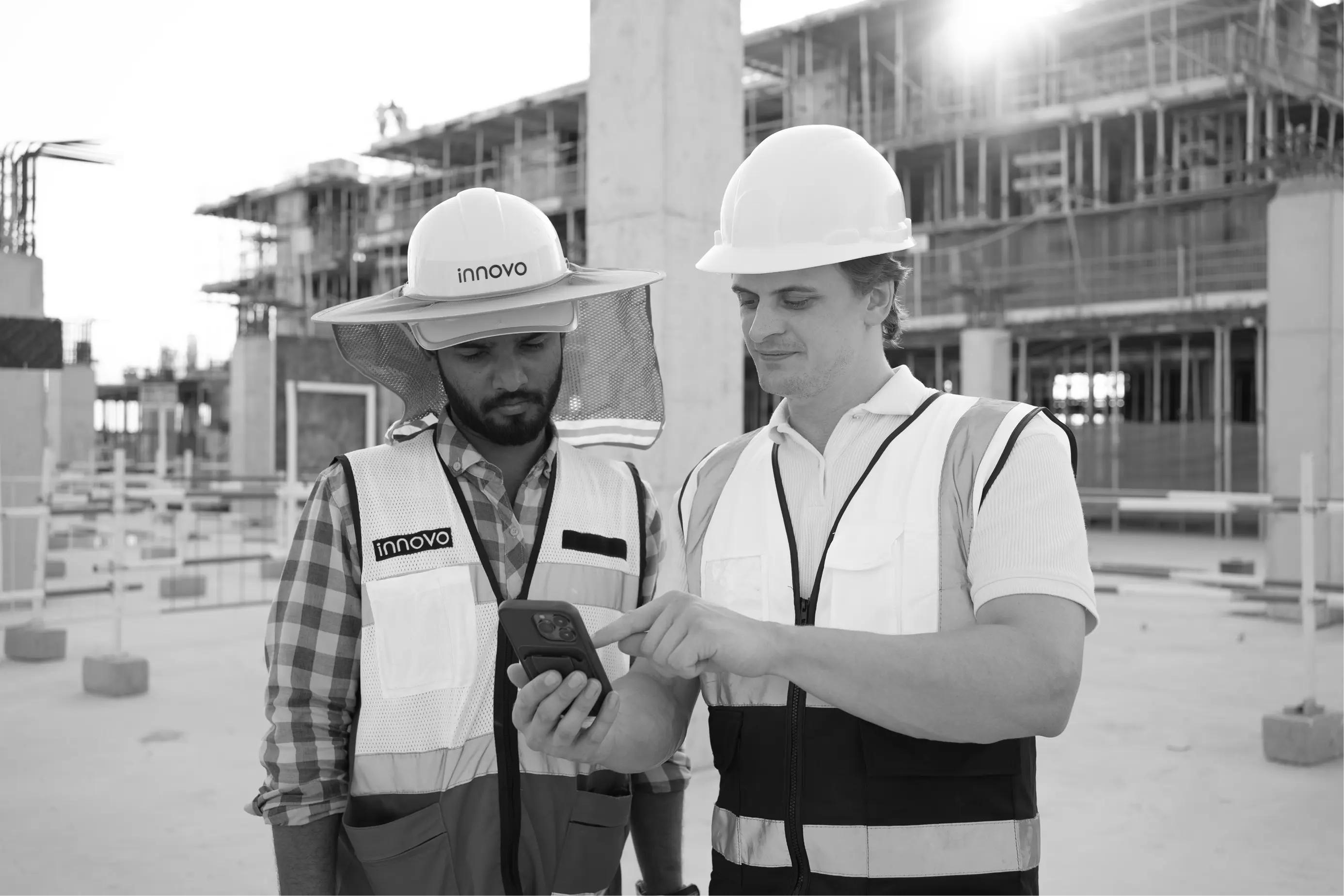
Quantavist co-founder Oscar Pickerill reviews AI safety alerts on a phone with an Innovo site team member at Ghaf Woods in DubaiQuantavist co-founder Oscar Pickerill reviews system alerts with an Innovo site team member at Ghaf Woods in Dubai, the first project to use the AI safety system. (Image source: Quantavist)

Dubai, UAE - Innovo has extended an AI-based worker safety system from Quantavist to several of its UAE construction projects, the two companies said at Big 5 Global 2026, with high-severity alerts down 59% at the first site.

The system picks up critical safety risks as they happen and passes them to the site team in charge. On one Dubai project, a pilot goes a step further and addresses workers directly, in several languages.

The companies have worked together since July 2025, when Innovo named itself Quantavist’s lead innovation partner in construction, starting with a live pilot on one of its flagship projects.

Innovo described the partnership as part of its commitment to worker welfare, health and safety, and said it applies technology with a clear purpose so that projects are delivered with excellence and speed.

Quantavist’s software steers robotic pan-tilt-zoom (PTZ) cameras that watch selected work fronts around the clock. The cameras are trained on the kinds of high-risk activity tied to the industry’s worst incidents: working at height, gaps in edge protection, activity in lifting zones, people straying into areas where vehicles or equipment operate, and missing personal protective equipment (PPE).

Alerts are sent to the safety engineers in charge, who acknowledge them, fix the issue and upload proof. The AI checks the proof and the safety team approves it before the alert can be closed, so every case leaves an auditable trail.


Ghaf Woods was the first site to run the system, and high-severity alerts there dropped 59% from the first to the third quarter of 2026. Innovo is main contractor for the first two phases of the Majid Al Futtaim community, which is planned to have more than 7,000 residential units and where the developer launched the 348-apartment Lyra in November.

At Alba Residences, another Innovo project, alerts per worker-hour came down 45% in the first two weeks after deployment.

Most critical alerts were taken up by the team in charge within minutes, and more than 90% of all alerts were resolved inside set response times. By Quantavist’s estimate, the system took roughly 1,000 hours of manual alert handling off site teams’ workloads from January to May 2026.

Douglas Zuzic, Chief Digital Officer at Innovo Group, said: “Our live projects give us a platform to prove new technologies against real project challenges and to scale what works. We judge every innovation by what it delivers in time, cost, quality, safety and sustainability. Quantavist’s technology has met that test, which is why we have extended it beyond its first site. Using AI in this way also supports the UAE’s priorities for AI adoption and technology-enabled infrastructure, set out in the National Strategy for Artificial Intelligence 2031 and the ‘We the UAE 2031’ vision.”

Ghaf Woods is also the test bed for a customised, closed-loop voice-warning system built to respond to identified site risks. Rather than only notifying supervisors, it talks to the worker.

When a worker is spotted somewhere dangerous, such as close to an unprotected edge or within a lifting zone, directional speakers issue a spoken instruction tailored to that particular hazard. The instructions come in several languages to suit the multinational workforce on Innovo’s sites, and the system then checks that the worker has moved clear.

In the pilot, an average of 8.4 seconds passed between a hazard being detected and the instruction being spoken. Safety teams on site remain in control, and every intervention is logged with its result for later review.

Gareth Main, Group HSE Director at Innovo GroupGareth Main, Group HSE Director at Innovo Group, said the system gives site teams round-the-clock visibility of high-risk work. (Image source: Innovo)

Gareth Main, Group HSE Director at Innovo Group, said: “Safety is a core pillar of our business, and we are committed to maintaining high standards across all our sites. On an active project, no safety team can observe every work front on every shift, and critical-control failures can occur between inspections. This system gives our teams round-the-clock visibility of high-risk activities on the work fronts it monitors and makes sure alerts reach the right team and are followed through to a verified close-out. For our site teams, that means more time on corrective action and less on manual monitoring.”

As both client and operating partner, Innovo has contributed its site requirements, safety workflows and knowledge of conditions on the ground, which the companies said has helped Quantavist adapt and develop the technology for live construction sites.

Oscar Pickerill, Co-founder of Quantavist, said: “For too long, construction safety technology has focused on digitising how safety is documented. Safety teams deserve technology that takes a more active role in supporting their work. Through our partnership with Innovo, we’re pushing the limits of what is possible to make autonomous risk control a fundamental part of how major projects operate, with systems that work alongside safety teams and close the full loop.”

Weekly reports show which work areas, zones, shifts and subcontractors keep generating risks, so teams can target their oversight.

Looking further out, Innovo said the data could support predictive safety analytics powered by AI and be fed into its existing construction digital twins, so that safety becomes part of broader project planning and supervision.