Financing Conditions Support Market Activity
Saudi Arabia’s macroeconomic environment in early 2026 reflected a period of adjustment, influenced by external pressures and evolving domestic policies.
Real GDP growth moderated to 2.8 percent year-on-year in Q1, while full-year forecasts for 2026 were revised to 1.9 percent, due to a significant reduction in oil production and exports and softer non-oil expansion.
Inflation remained stable at 1.8 percent. Foreign direct investment recorded strong momentum, rising 90 percent year-on-year in Q4 2025, signalling confidence in the Kingdom’s long-term prospects.
Fiscal policy remains expansionary, supporting major infrastructure investment alongside capital market reforms aimed at improving liquidity and investor access.
Against this backdrop, the real estate sector continued to demonstrate strength. Transaction values reached $29.85 billion (SAR 112 billion) in Q1 2026, up 6.8 percent year-on-year, supported by improved financing conditions and stronger access to capital.
Regulatory reforms, including foreign ownership measures and increased market transparency, are also strengthening institutional participation and aligning the sector more closely with global standards.
Development Pipeline Shifts Toward Delivery
Saudi Arabia’s development pipeline is evolving from construction-led growth toward delivery, operations and long-term asset management.
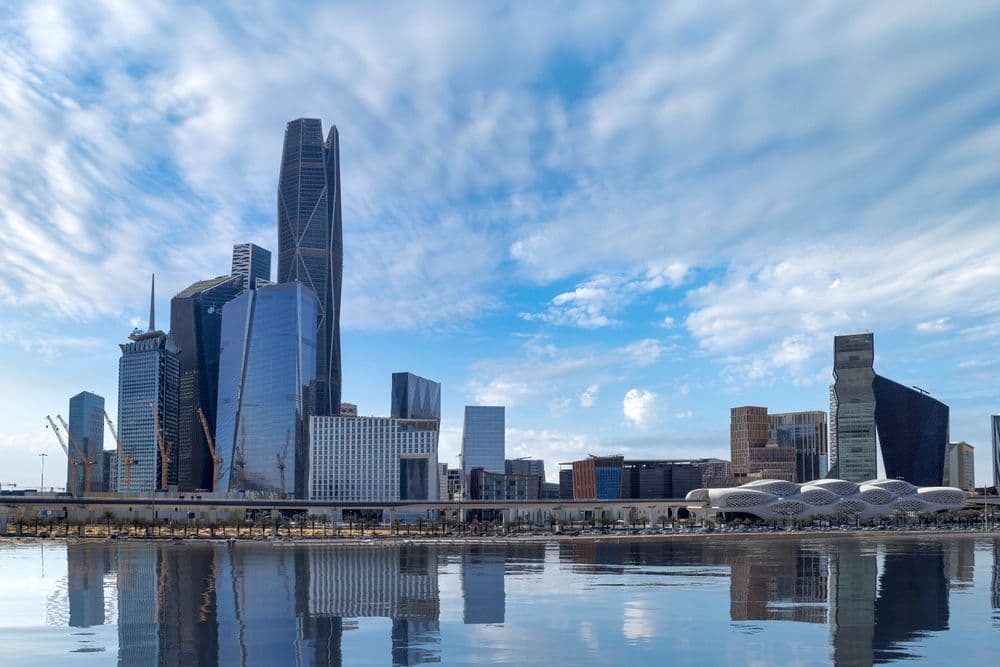
Major projects continue to advance, with Riyadh remaining the focal point of activity. Strategic repositioning is also visible across flagship developments, including NEOM’s growing focus on AI and data infrastructure, alongside continued progress on projects such as Diriyah and Jeddah Tower.
This sustained pipeline, backed by public and private investment, reinforces the Kingdom’s long-term Vision 2030 ambitions and its broader objective of building a more diversified, investment-led economy.
Office Market Remains Undersupplied
Saudi Arabia’s office market remains fundamentally undersupplied, particularly in the prime segment, with Grade A occupancy levels close to full capacity.
Demand continues to be driven by the Regional Headquarters programme, which has encouraged hundreds of international firms to establish a physical office presence in the capital.
While new supply is expected to moderate rental growth over the longer term, structural demand continues to exceed availability.
Across Jeddah and Dammam, office performance remains stable, although a clear divergence is emerging between modern Grade A assets and older stock. Occupiers are increasingly prioritising quality, flexibility and digital infrastructure when selecting office space.
Retail Sector Adapts to Digital Commerce
Saudi Arabia’s retail sector is continuing to shift toward digital commerce, with electronic payments accounting for 85 percent of total retail payments in 2025.
Domestic consumption, particularly across food and beverage and fashion, remains strong, helping to stabilise the sector and offset fluctuations in international tourism.
New retail supply is increasingly being integrated into mixed-use masterplans, with developers prioritising food and beverage outlets as key footfall drivers.
Major projects including The Avenues Riyadh, Westfield Jeddah and Westfield Riyadh are expected to add significant new retail space.
Despite market shifts, rents for super-regional and regional malls have remained stable, with landlords generally maintaining rates and not widely offering concessions.
The focus for successful retail centres is increasingly moving toward walkable, community-centric environments that combine wellness, luxury, digital features and experiential retail.
As Saudi Arabia’s real estate market moves through 2026, performance is expected to remain shaped by regulation, capital access, supply delivery and the continued evolution of demand across residential, office and retail sectors.