Riyadh, Saudi Arabia - Grade A offices in Riyadh were about 97% occupied in the third quarter of 2026, CBRE Middle East said in a review that found firm occupier demand and growing pipelines across the Kingdom’s property sectors.
The consultancy’s Saudi Arabia Real Estate Market Review covers the office, residential, retail, hospitality and industrial markets, and reports continued investment activity and expanding development pipelines in each of them.
The wider economy kept its underlying momentum, CBRE said, even though real GDP contracted by 4.8% year on year in Q2 2026. Construction, transport, professional services and manufacturing were among the non-oil sectors that went on driving activity.
The Riyad Bank Saudi Arabia PMI climbed to 55.3 in September, its best reading since February. Inflation stood at a relatively contained 1.9% the same month, though the review said costs tied to construction materials, logistics and project delivery are still weighing on parts of the property sector.
Across Saudi Arabia, development work stayed focused on execution, with infrastructure delivery to the fore. Diriyah was one of the busiest destinations of the quarter, where contracts worth around $728 million (SAR 2.73 billion) went out for hospitality and residential schemes in Diriyah Square, including six luxury hotels and branded residential products.
Nationwide, real estate transactions were worth $6.51 billion (SAR 24.4 billion) in August. Residential assets made up 73% of that value, or $4.77 billion (SAR 17.9 billion).
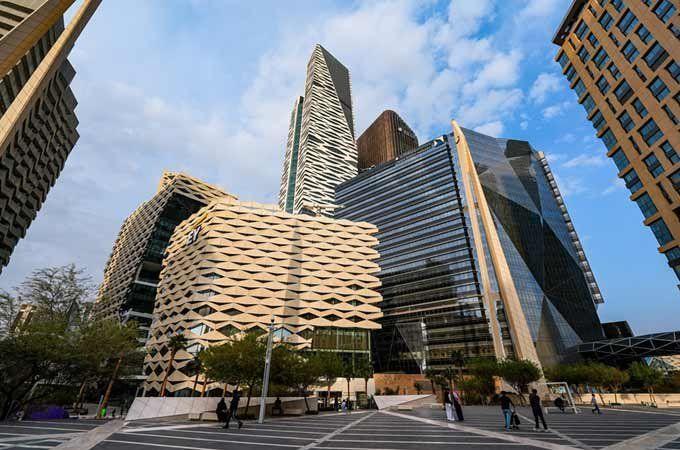
Offices remained one of the best-performing asset classes in the country, according to CBRE. Occupancy at King Abdullah Financial District (KAFD) held at around 99%, close to full capacity.
Demand from multinational companies, regional headquarters and growing domestic businesses kept outpacing supply, the consultancy said. That pushed prime office rents up 3% year on year to $885 (SAR 3,320) per sq m per annum, while Grade A rents averaged $685 (SAR 2,570) per sq m per annum.
Riyadh’s total office stock now exceeds 6.3 million sq m. Another 1.7 million sq m is due for delivery between late 2026 and 2028.
The office figures compare with CBRE’s review of the same quarter in 2025, which recorded a 15% annual rise in Grade A office rents and average occupancy of 98%.
In housing, affordability and access stayed the main themes. Residential transaction values fell 8% year on year and volumes 7%, and the average price of apartments per sq m across the country dropped 3.6%.
Riyadh again did better than the national market, with apartment prices up 2.3% on the year. Rental performance differed by district: apartment rents rose 5% in Al Sulaymaniyah and 4% in both Al Nasim Al Gharbi and Al Yarmouk, which CBRE said showed continued demand in selected submarkets despite a wider slowdown.
Retail fundamentals stayed positive on the back of domestic consumer spending, the review found. Point-of-sale spending nationwide grew 3.5% to $3.57 billion (SAR 13.37 billion) over a seven-day tracking period ending in September, and hotels, recreation, restaurants and cafés each posted double-digit growth.
Westfield Riyadh is expected to add about 120,000 sq m of retail space by the end of the year. CBRE said that scheme and The Avenues Riyadh will further widen the Kingdom’s retail offer.
In hospitality, domestic tourism continued to make up for weaker international travel. Domestic trips rose 16% year on year to 28.9 million in the first quarter of 2026, and total tourist numbers grew 8% to 37.2 million.
Inbound arrivals fell 13% to 8.3 million, which contributed to a 2% drop in overall tourism spending to $22.05 billion (SAR 82.7 billion). National hotel performance held relatively steady, with average daily rate (ADR) up 3.7% and revenue per available room (RevPAR) up 3.3% year on year in September.
Matthew Green, Head of Research at CBRE MENA, said: “Despite the geopolitical landscape regionally, Saudi Arabia's real estate market continues to be supported by powerful long-term drivers linked to Vision 2030, economic diversification and sustained investment across infrastructure, tourism, logistics and urban development. Whilst a more cautious operating environment has evolved since March, occupier demand across key sectors remains robust and development activity continues to progress. The office market remains characterized by exceptionally low vacancies and a shortage of premium space, while residential demand continues to be supported by population growth and housing initiatives. At the same time, the logistics sector is benefitting from Saudi Arabia's growing role as a regional trade and distribution hub, and the continued expansion of tourism infrastructure is creating new opportunities across the hospitality and retail sectors.”
He added: “Looking ahead, we expect the Kingdom's real estate market to remain firmly supported by ongoing public and private sector investment, a substantial project pipeline and the continued delivery of Vision 2030 initiatives.”
Industrial and logistics property kept gaining from rising occupier demand and investment in supply chain infrastructure, according to the review. The Saudi Ports Authority has reported cumulative investment of around $3.89 billion (SAR 14.6 billion) across the Kingdom’s ports and logistics network.
Logistics developer ESR has announced plans for a new platform aimed at Saudi Arabia and the UAE, with a development pipeline of more than three million sq m.
Rents rose fastest in the main logistics hubs. Riyadh East averaged $83 (SAR 313) per sq m per annum, up 15.1% year on year, while Jeddah South posted the strongest growth in the country, with rents up 16.7% to $58 (SAR 217) per sq m per annum.