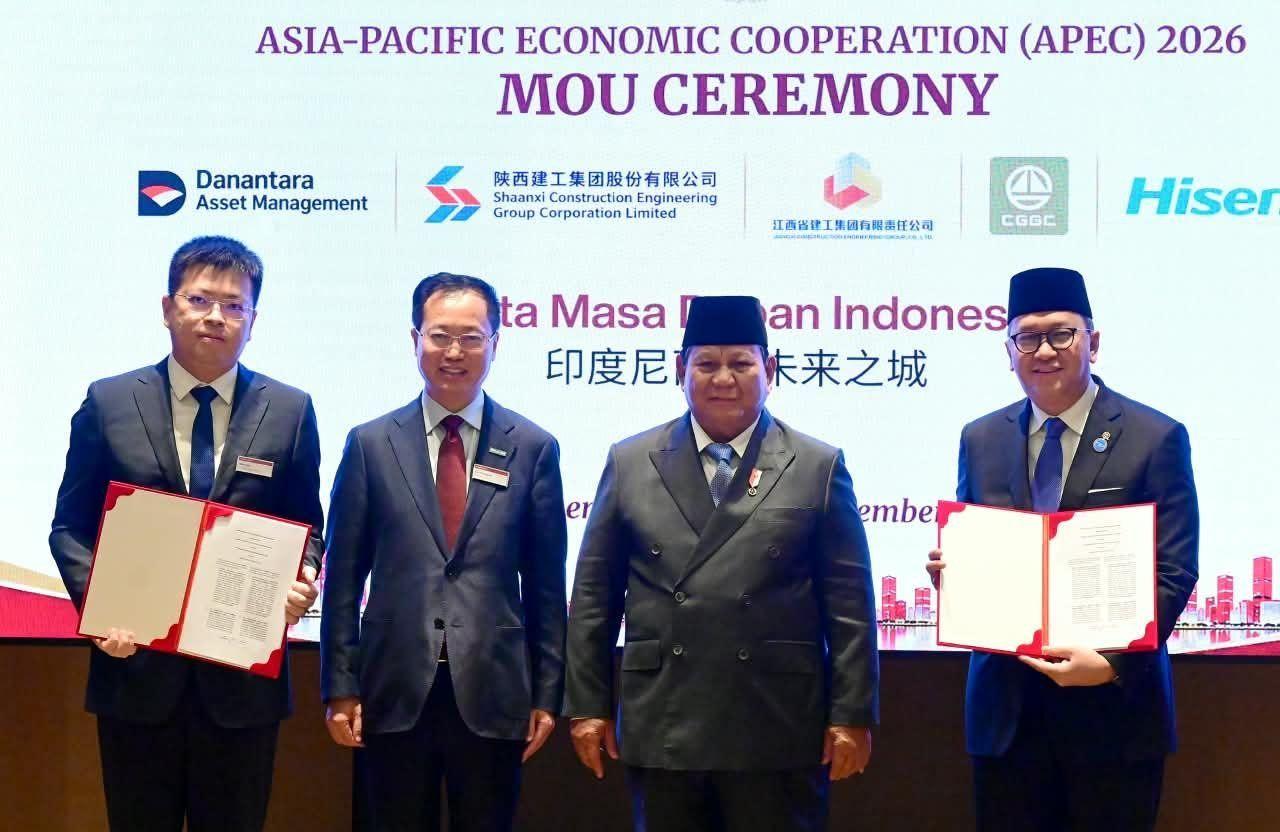
Shenzhen, China - Indonesia and China have agreed investments and commitments worth approximately $71.8 billion (more than IDR 1,300 trillion), the largest being a $50 billion programme to build 10 initial “future smart city” sites, Indonesia’s Cabinet Secretariat said.
The memoranda of understanding (MoU) and firmer commitments were exchanged on Wednesday 18 November in Shenzhen, Guangdong province, with President Prabowo Subianto present. Besides smart cities, the package takes in manufacturing and technology, financing for infrastructure and a coal-to-ethanol scheme.
Valued at approximately $50 billion, the smart city agreement pairs PT Kota Masa Depan Indonesia, which sits under Danantara Indonesia, with a Shaanxi-led consortium.
Rosan Roeslani, Minister of Investment and Downstreaming and CEO of Danantara, said: “That will become a historical project to be implemented next year.”
The signing comes a month after Danantara completed a $533 million deal in Makkah, where it plans 6,000 hotel rooms.
More detail came in a newswire release put out the same day during APEC Economic Leaders’ Week. PT Danantara Asset Management owns 99% of PT Kota Masa Depan Indonesia, it said, and the MoU with the Shaanxi Construction Engineering Group Corporation Limited consortium, which also counts Hisense and other Chinese firms as members, is non-binding.
Each of the 10 cities carries an indicative price of $5 billion, according to the release. Together they would hold roughly 1.5 million homes, plus the infrastructure needed for some 3 million people. The consortium aims to build public amenities, municipal works, utilities and digital networks within three to five years, once procurement is complete.
The cities are laid out as self-contained neighbourhoods. Homes would range from affordable and family units to rental and worker accommodation, resettlement housing and residences for older people, grouped around schools up to university level, hospitals and local clinics, mosques and other places of worship, markets, parks and municipal service centres.
Yang Haisheng, President of Shaanxi Construction Engineering Group Co., Ltd. (SCEGC), said: “A city planned from the start with digital services, clean water and efficient energy gives Indonesian families a better place to live and gives investors a clear picture of how Indonesia intends to build. We bring engineering and smart-city experience that we want to apply here, and we see Indonesia as a market worth committing to for the long term.”
Rosan said the agreements showed strong confidence in Indonesia as an investment destination and would open up jobs while building up the country’s own technology base.
“This will indeed have a positive impact on job creation and will also facilitate technology transfer,” he said.
The minister said the smart city, manufacturing, infrastructure financing and coal-to-ethanol initiatives belong to a wider push to deepen investment links between the two countries, with the focus on productive and value-added projects.
On infrastructure, Danantara reinforced a funding partnership worth approximately $10 billion with a consortium headed by China’s State Development and Investment Corporation (SDIC).
Chinese appliance and electronics maker Hisense also deepened its presence in the country through a tie-up with Danantara and Indonesia’s Ministry of Higher Education, Science, and Technology. Worth approximately $10 billion, it spans a shared R&D laboratory, training of local talent and the production of household appliances.
A further MoU, for a $1.8 billion plant turning coal into ethanol, was exchanged in Prabowo’s presence. The same ministry signed it with state-owned oil and gas company Pertamina, and Beijing Petrochemical Engineering Co., Ltd. joins as partner. The collaboration is also meant to support development and technology transfer within Indonesia.