Sign up to receive the latest tech news and updates from Property News International straight to your inbox.
By signing up, you will receive emails about property news products and you agree to our terms of use and privacy policy.
@2026 Property News International. All Rights Reserved.
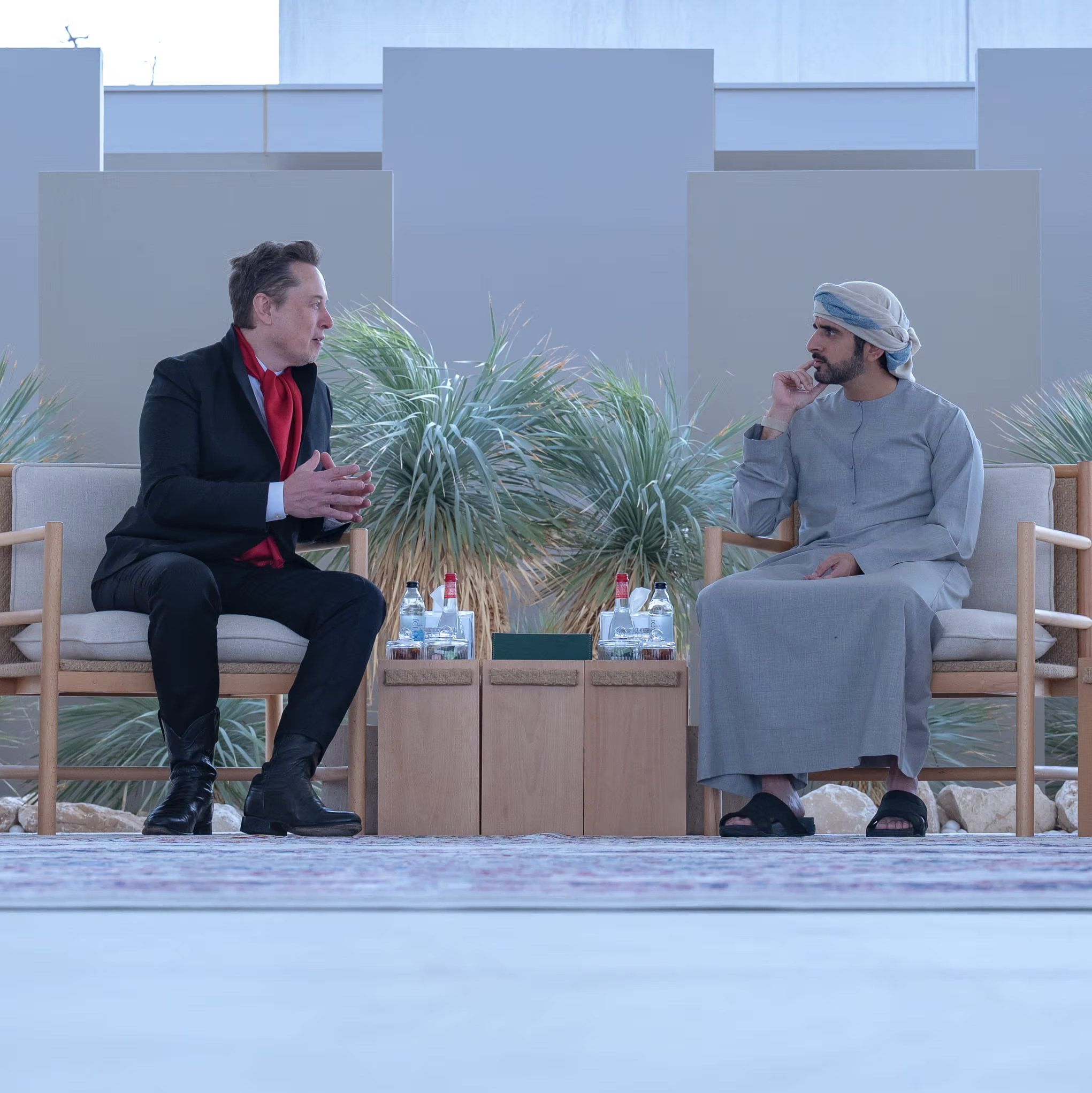
His Highness Sheikh Hamdan bin Mohammed bin Rashid Al Maktoum, Crown Prince of Dubai and Deputy Prime Minister of the UAE, met with Elon Musk in December 2025. Image: Dubai Media OfficeDubai, UAE: Dubai has officially commenced construction of the first phase of the Dubai Loop, a next-generation underground transport system developed in partnership with Elon Musk’s The Boring Company, marking a major step in the emirate’s long-term mobility and congestion-reduction strategy.
The Dubai Loop project was announced by His Highness Sheikh Hamdan bin Mohammed bin Rashid Al Maktoum, Crown Prince of Dubai, as part of the emirate’s wider smart mobility strategy. The initiative aligns with Dubai’s long-term vision to deploy advanced transport technologies that improve connectivity, reduce congestion, and support sustainable urban growth, reinforcing the city’s ambition to remain at the forefront of future-ready mobility solutions.
The initial phase of the project, valued at $163 million (AED600 million), will span 6 kilometres and is expected to be completed within two years, according to Mattar Al Tayer, Director General and Chairman of the Board of Executive Directors at Dubai’s Roads and Transport Authority (RTA). The announcement was made during the World Government Summit in Dubai.
The Dubai Loop is envisioned as a high-capacity underground transport network using electric vehicles operating through dedicated tunnels, enabling rapid point-to-point travel across key urban districts. Once fully completed, the system will extend 24 kilometres, with a total projected investment of $680 million (AED2.5 billion) and a capacity of approximately 13,000 passengers per day.
The first phase will be constructed in and around Dubai’s financial district, described by Al Tayer as “the key commercial area of Dubai.” Construction officially began this week.
Al Tayer highlighted the project’s cost efficiency, noting that tunnelling costs are significantly lower than traditional metro construction.
“There’s a big difference in the costs,” he said.
Each kilometre of tunnel for the Dubai Loop will cost approximately $19 million (AED70 million) to bore, compared to $34 million (AED125 million) per kilometre for conventional metro tunnels. The cost reduction is enabled by The Boring Company’s specialised, high-speed tunnelling technology designed for narrow, low-cost underground corridors.
The implementation of the first phase of Dubai Loop project will commence with the construction of a 6.4km pilot route, comprising four stations and linking the Dubai International Financial Centre and Dubai Mall. This phase will pave the way for expansion into the full project… pic.twitter.com/5o1yfMiGJB
— RTA (@rta_dubai) February 3, 2026
Under the agreement, The Boring Company will deploy its proprietary tunnel-boring machines to create infrastructure tailored for autonomous electric vehicles, primarily Tesla cars. While the Las Vegas Loop remains the only operational system to date, Dubai’s version is expected to scale significantly larger.
Al Tayer confirmed that additional phases will follow, although specific locations beyond the first stage have not yet been disclosed.
“The project will add much to the infrastructure of Dubai. The first stage will be executed within two years. The second stage we’ll try even earlier, but let’s begin first,” he said.
The Boring Company has indicated that the Dubai Loop could support speeds of up to 160 kilometres per hour, potentially reducing travel times between major destinations to just minutes.
Dubai’s investment in underground mobility comes amid rising congestion pressures. Residents currently spend an average of 35 hours per year delayed in traffic, according to regional traffic analytics based on 2024 data from INRIX and TomTom. Globally, congestion is estimated to cost the economy more than $500 billion annually.
Alongside the Dubai Loop, the UAE continues to explore a range of advanced mobility solutions, including autonomous taxis, self-driving buses, and aerial transport. Al Tayer confirmed that 100 autonomous taxis are expected to be operating in Dubai during the first quarter of this year, with plans to expand the fleet to 1,000 vehicles.
Meanwhile, California-based Glydways is also working with authorities in Dubai and Abu Dhabi to assess the deployment of its autonomous mass-transit system, which operates on dedicated lanes and can be integrated at ground level or underground.
Together, these initiatives reflect Dubai’s broader ambition to future-proof its transport infrastructure, improve urban efficiency, and position itself as a global leader in smart mobility.

Amna Fayaz discusses how acoustics is shaping healthier, smarter and more productive workplaces

Hollywood Chamber of Commerce launches Hollywood Hotels & Residences with The Scene Hotels & Resorts

Aedas unveils the 376-unit Rixos Al Reem Residences, bringing branded waterfront living to Abu Dhabi

AtkinsRéalis and ALEC will deliver Sphere Abu Dhabi, opening on Yas Island in 2029