Dubai, UAE: The Dubai PropTech Hub, an initiative of Dubai International Financial Centre (DIFC) in partnership with the Dubai Land Department (DLD), has released a new whitepaper titled “PropTech 2033”, outlining how technology-driven transformation in the real estate sector could generate significant economic value for Dubai in the coming decade.
According to the report, PropTech innovation could unlock more than $14.4 billion (AED53 billion) in annual worker productivity gains for the emirate, highlighting the growing role of technology in shaping the future of urban development, property markets, and real estate operations.
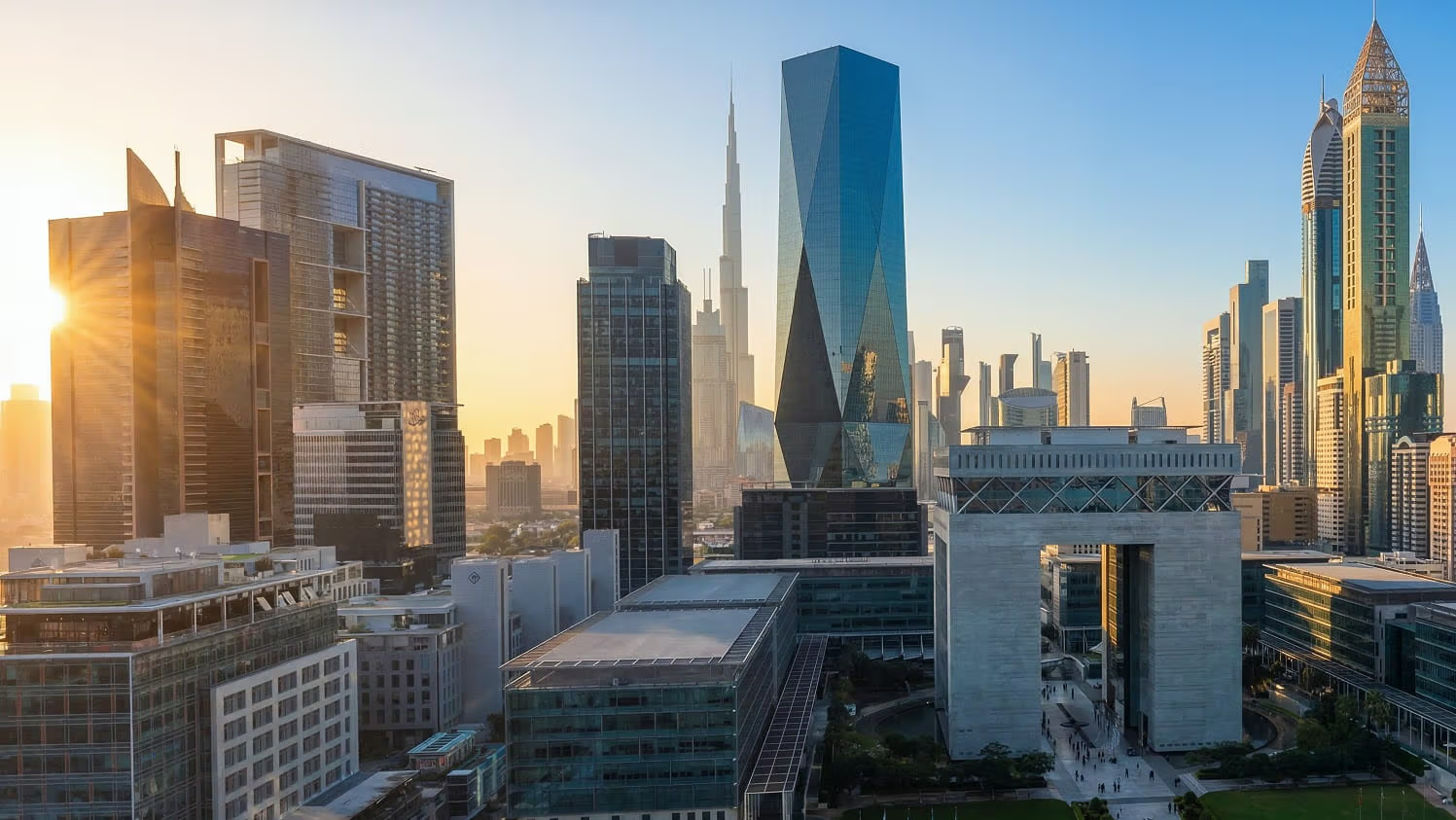
The Dubai PropTech Hub is based at the DIFC Innovation Hub, part of DIFC’s broader strategy to position the emirate as a global centre for innovation in financial and real estate technologies.
Strategic Framework for the Next Phase of PropTech Growth
The PropTech 2033 whitepaper analysed 18 strategic agendas across the UAE and the United Nations to map the next phase of growth for Dubai’s PropTech ecosystem. Key policy frameworks considered in the research include the Dubai Economic Agenda D33, the Dubai Real Estate Sector Strategy 2033, and the Dubai Urban Master Plan 2040.
The analysis identified 833 global PropTech business models focused on improving quality of life while supporting economic growth across the real estate sector. Notably, just two of these identified business cases alone represent potential economic value exceeding $14.4 billion (AED53 billion) annually for Dubai’s economy.
The report also highlights a broader structural shift taking place across the global built environment, where PropTech is evolving beyond traditional digital tools into AI-native, system-level urban infrastructure capable of integrating planning, operations, sustainability, and human experience.
This transformation, the whitepaper notes, is redefining how value is created across the real estate sector by enabling more efficient operations, sustainable development practices, and smarter urban environments.
The whitepaper suggests that Dubai is uniquely positioned to lead this next wave of urban innovation due to its supportive regulatory environment, strong infrastructure, and forward-looking economic vision.
Key factors contributing to Dubai’s competitive advantage include the regulatory agility of DIFC, the emirate’s experience with climate-adaptive development, its rapid adoption of advanced technologies, and its ambition to become one of the world’s top four global financial centres.
As part of the initiative, the Dubai PropTech Hub has opened applications for its inaugural “Global Landing Pad” programme, designed to support international PropTech scale-ups seeking to enter the Dubai and MEASA markets.
The programme will provide selected companies with access to mentorship and expertise from leading industry players, including Binghatti, Majid Al Futtaim, Union Properties, Sobha, and Transguard.
This initiative builds on the Hub’s existing programmes aimed at strengthening the local innovation ecosystem, including the PropTech Elevate programme, which supports emerging PropTech startups in scaling their solutions.
PropTech Driving Economic Growth and Urban Innovation
Mohammad AlBlooshi, Chief Executive Officer of DIFC Innovation Hub commented:
DIFC’s PropTech 2033 whitepaper demonstrates that PropTech is no longer a peripheral enabler of real estate, but an engine of economic growth, productivity, and urban resilience. This whitepaper reinforces DIFC’s commitment to positioning Dubai as the global epicentre for PropTech innovation and sustainable urban growth, whilst accelerating the Emirate’s ambitions of doubling the economic contribution of the sector by 2033.
Majid Al Marri, CEO of the Real Estate Registration Sector at Dubai Land Department, said:
The PropTech 2033 white paper reaffirms Dubai’s commitment to future-proofing its real estate sector through innovation, data, and advanced technologies that strengthen transparency and investor confidence. This direction is reflected in the Dubai PropTech Hub, established in partnership between Dubai International Financial Centre and Dubai Land Department, and reinforced by hosting PropTech Connect Middle East. Together, these initiatives advance the Dubai Economic Agenda D33 and the Dubai Real Estate Strategy 2033, enhancing global competitiveness and ensuring the long-term sustainability of Dubai’s real estate ecosystem.
The Dubai PropTech Hub currently tracks 231 UAE-based PropTech companies, with a strong concentration in property listings, real estate investment platforms, and marketing technologies.
However, the report highlights substantial opportunities for diversification across emerging areas including climate resilience technologies, AI-driven building operations, and productivity-focused real estate solutions.
By providing a platform for experimentation, scaling, and international collaboration, the Hub aims to position Dubai as a global launchpad for next-generation PropTech innovations aligned with sustainability, wellbeing, and future mobility solutions.
Supporting DIFC’s Innovation District Expansion
Dubai’s PropTech ambitions are also closely linked to the expansion of DIFC’s Zabeel District, where more than 1 million sq. ft. has been allocated for what is set to become the world’s largest innovation hub and the first purpose-built AI Campus.
The expansion of DIFC from the Gate District into the Zabeel District forms part of the emirate’s broader strategy to strengthen its position among the world’s leading financial centres, in line with the Dubai Economic Agenda D33 and DIFC’s vision for 2030.
The new district will incorporate energy-efficient architecture, smart infrastructure, and sustainable mobility solutions, reinforcing Dubai’s commitment to building resilient and future-ready urban environments.