Property News International

Subscribe to Our Newsletter

Sign up to receive the latest tech news and updates from Property News International straight to your inbox.

By signing up, you will receive emails about property news products and you agree to our terms of use and privacy policy.

@2026 Property News International. All Rights Reserved.

Blends Media
A Blends Media Group Production

Jeanne Gang: The Architect Challenging Convention

Bardia S.
Bardia S.
Oct. 22, 2026
Jeanne Gang, founding partner of Studio Gang, has built an international reputation through architecture that connects people, cities and the natural environment. From Chicago's sculptural towers to major cultural institutions, her work demonstrates how innovative design can transform urban spaces.
Jeanne Gang, founding partner of Studio Gang, an international architecture and urban design practice headquartered in Chicago.Jeanne Gang, founding partner of Studio Gang, an international architecture and urban design practice headquartered in Chicago. (Image source: Galerie Magazine – Creative Mind: Jeanne Gang)

USA, Chicago - Few contemporary architects have explored the relationship between buildings, people and the natural environment as extensively as Jeanne Gang. As the founding partner of Studio Gang, she has developed an international practice whose work ranges from landmark skyscrapers and cultural institutions to public parks, educational facilities and urban regeneration projects.

Her architectural approach combines experimentation with materials, environmental research and a commitment to creating spaces that strengthen connections between communities and their surroundings.

Over nearly three decades, Gang has helped expand the possibilities of contemporary architecture, demonstrating that ambitious design can serve both the practical needs of a city and the people who experience it every day.

Building an international architectural practice

Gang established Studio Gang in Chicago in 1997, developing the firm into an international architecture and urban design practice with offices in Chicago, New York, San Francisco and Paris.

A graduate of the University of Illinois Urbana-Champaign and Harvard Graduate School of Design, she also studied at ETH Zurich through a Rotary Ambassadorial Scholarship.

Her education and early professional experience helped shape an architectural approach grounded in research, technical experimentation and an interest in how the built environment interacts with natural systems.

Today, Studio Gang works across residential, commercial, cultural, educational and civic architecture, with projects demonstrating a consistent interest in design that responds to its particular location and community.

Alongside leading the practice, Gang serves as Kajima Professor in Practice of Architecture at Harvard Graduate School of Design, where her teaching and research examine materials, building reuse and the relationship between architecture, culture and the environment.

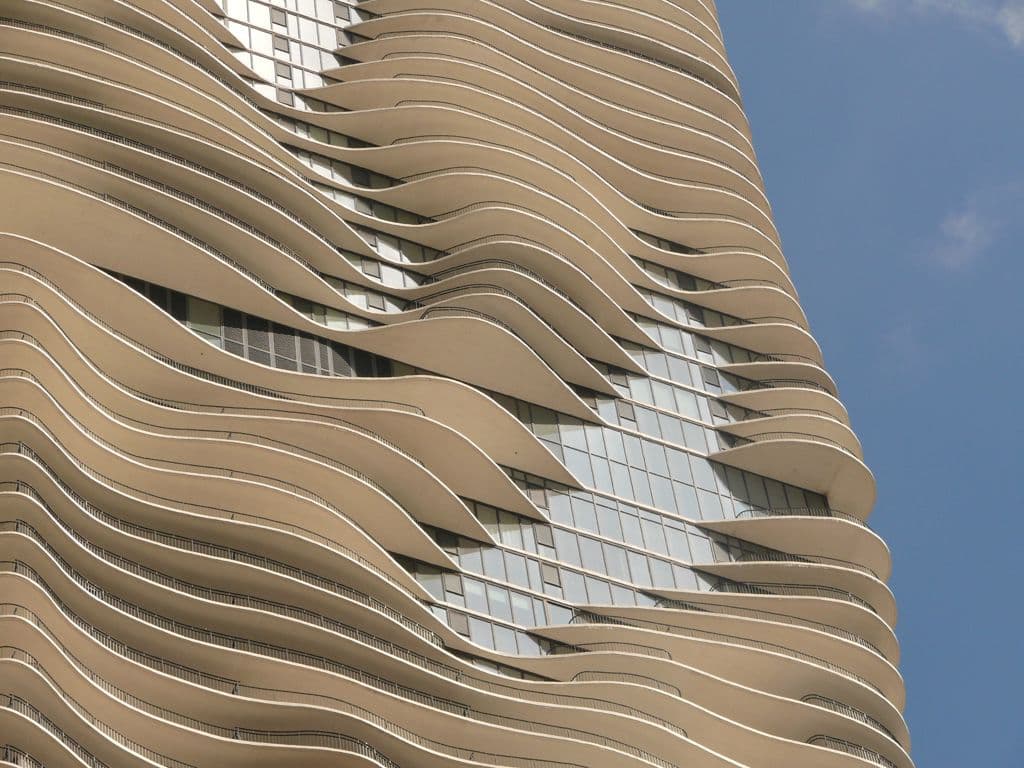
Aqua Tower in Chicago, designed by Studio Gang, is distinguished by its undulating balconies across 82 storeys.Aqua Tower in Chicago, designed by Studio Gang, is distinguished by its undulating balconies across 82 storeys. (Image source: Studio Gang – Aqua Tower official project gallery)

Redefining Chicago's skyline

Among Gang's most widely recognised achievements is Aqua Tower in Chicago, completed in 2010.

The 82-storey residential skyscraper became internationally known for its sculptural concrete balconies, which extend and retract across the building's exterior to create an undulating façade.

Its distinctive form challenged conventional high-rise design while responding to environmental conditions and opportunities for outdoor residential space.

The project established Studio Gang as an influential practice in contemporary tall-building architecture.

Gang subsequently led the design of St. Regis Chicago, formerly known as Vista Tower, which was completed in 2021.

Rising 101 storeys, the building features three interconnected towers with a series of stepped setbacks and a distinctive blue-glass exterior.

The development further demonstrated Studio Gang's ability to combine complex engineering requirements with an ambitious architectural identity.

Together, Aqua Tower and St. Regis Chicago have become important additions to the city's architectural landscape, extending Chicago's longstanding tradition of experimentation in skyscraper design.

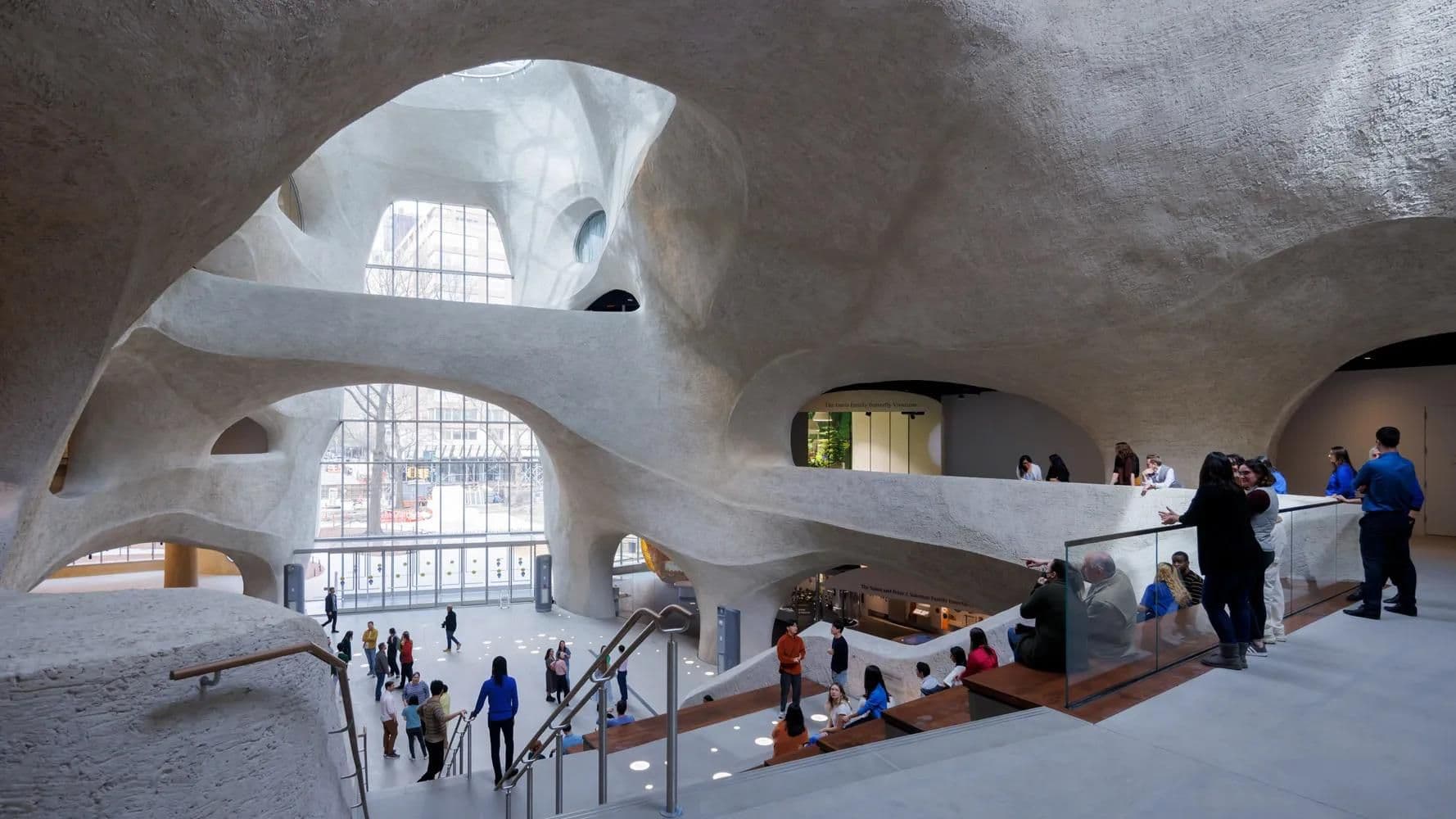
The Richard Gilder Center at New York's American Museum of Natural History features sweeping architectural forms and interconnected public spaces.The Richard Gilder Center at New York's American Museum of Natural History features sweeping architectural forms and interconnected public spaces. (Image source: American Museum of Natural History – Gilder Center)

Creating cultural buildings that connect communities

Gang's work extends well beyond residential towers.

In New York, Studio Gang designed the Richard Gilder Center for Science, Education, and Innovation at the American Museum of Natural History, which opened in 2023.

The museum extension brings together exhibition, education and research facilities through an architectural composition of interconnected spaces.

Its dramatic central atrium uses sweeping, organically shaped surfaces, bridges and openings to create a continuous visitor experience across multiple levels.

Rather than treating circulation as a secondary function, the project makes movement and exploration central to the architecture.

Another significant cultural project is the Arkansas Museum of Fine Arts in Little Rock, also completed in 2023.

Studio Gang's design transformed the institution through new connections between existing buildings, exhibition spaces and the surrounding landscape, improving access and creating a more welcoming environment for visitors.

These projects illustrate Gang's interest in public architecture that encourages interaction and creates stronger relationships between institutions and their communities.

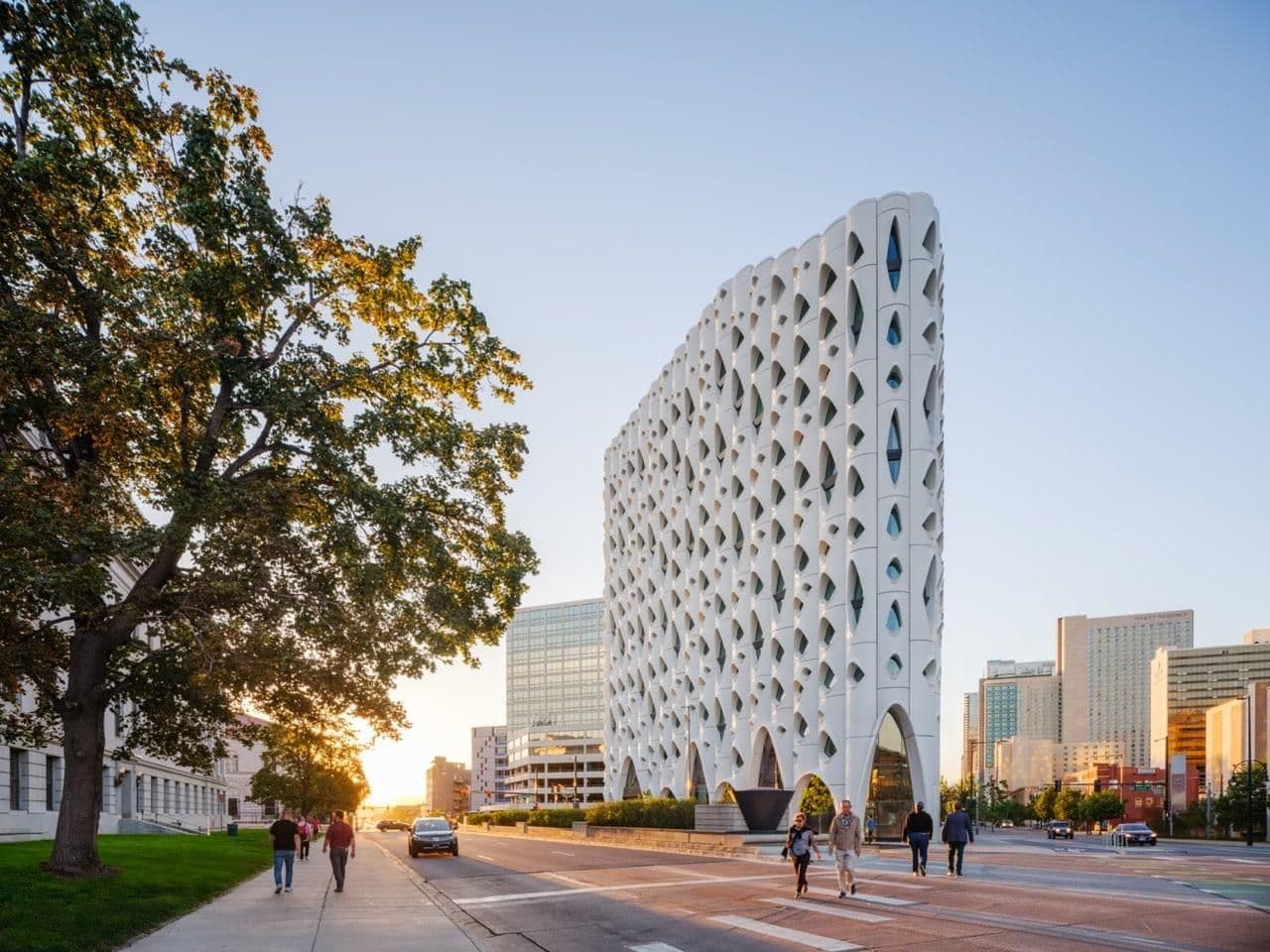
Populus, the 13-storey hotel in Denver designed by Studio Gang, features a sculptural façade inspired by Colorado's native aspen trees.Populus, the 13-storey hotel in Denver designed by Studio Gang, features a sculptural façade inspired by Colorado's native aspen trees. (Image source: Studio Gang – Populus official project photography)

Bringing nature into contemporary development

Environmental thinking is an important part of Gang's architectural practice.

Her work frequently draws inspiration from ecosystems, natural forms and the ways buildings can contribute positively to their surroundings.

At Populus in Denver, completed in 2024, Studio Gang developed a distinctive hotel building inspired by the characteristics of Colorado's native aspen trees.

The 13-storey, 265-room development features sculptural window openings that reference patterns found in aspen bark, giving the façade a recognisable identity while responding to the building's interior spaces.

The project reflects Gang's interest in using natural systems as a starting point for architectural design rather than treating sustainability as an isolated technical consideration.

That philosophy also appears in Studio Gang's public landscape projects, including Tom Lee Park in Memphis and the Nature Boardwalk at Lincoln Park Zoo in Chicago.

Through these developments, the practice has explored how urban spaces can support biodiversity, encourage social activity and reconnect cities with their natural environments.

Jeanne Gang, founding partner of Studio Gang, whose architectural work spans high-rise developments, cultural institutions and public spaces.Jeanne Gang, founding partner of Studio Gang, whose architectural work spans high-rise developments, cultural institutions and public spaces. (Image source: Studio Gang – Jeanne Gang official biography)

Leadership beyond architecture

Gang's influence extends into architectural education, professional practice and broader discussions about the responsibilities of designers.

She has advocated for greater equity within the architecture profession, including efforts to address gender-based pay disparities within Studio Gang.

Her work has also promoted bird-friendly building design and the use of architectural research to improve the environmental performance of cities.

Recognition of her achievements includes a MacArthur Fellowship, inclusion in TIME magazine's list of the world's most influential people, and the Cooper Hewitt National Design Award in Architecture.

In 2026, she was named a recipient of the Thomas Jefferson Foundation Medal in Architecture, adding to a career recognised by professional institutions internationally.

Her approach demonstrates that architectural leadership can extend beyond the delivery of individual projects to influence how the profession approaches environmental responsibility, social impact and design innovation.

Shaping the future of architecture

As Studio Gang continues its international expansion, its portfolio includes projects in education, civic infrastructure, cultural development and urban regeneration.

Among its ongoing commissions are work connected to the United States Embassy in Brasília and the expansion of the Clinton Presidential Center in Little Rock.

The practice's continued development reflects Gang's belief in architecture as a discipline capable of addressing complex urban and environmental challenges through research, collaboration and design.

From the skyscrapers of Chicago to museums, parks and public institutions across the United States and internationally, Jeanne Gang has established a body of work defined by its willingness to question established architectural conventions.

Her influence lies not simply in the buildings themselves, but in the wider understanding of how architecture can strengthen communities, respond to ecological conditions and create lasting value within the built environment.