A Career of Iconic Global Landmarks
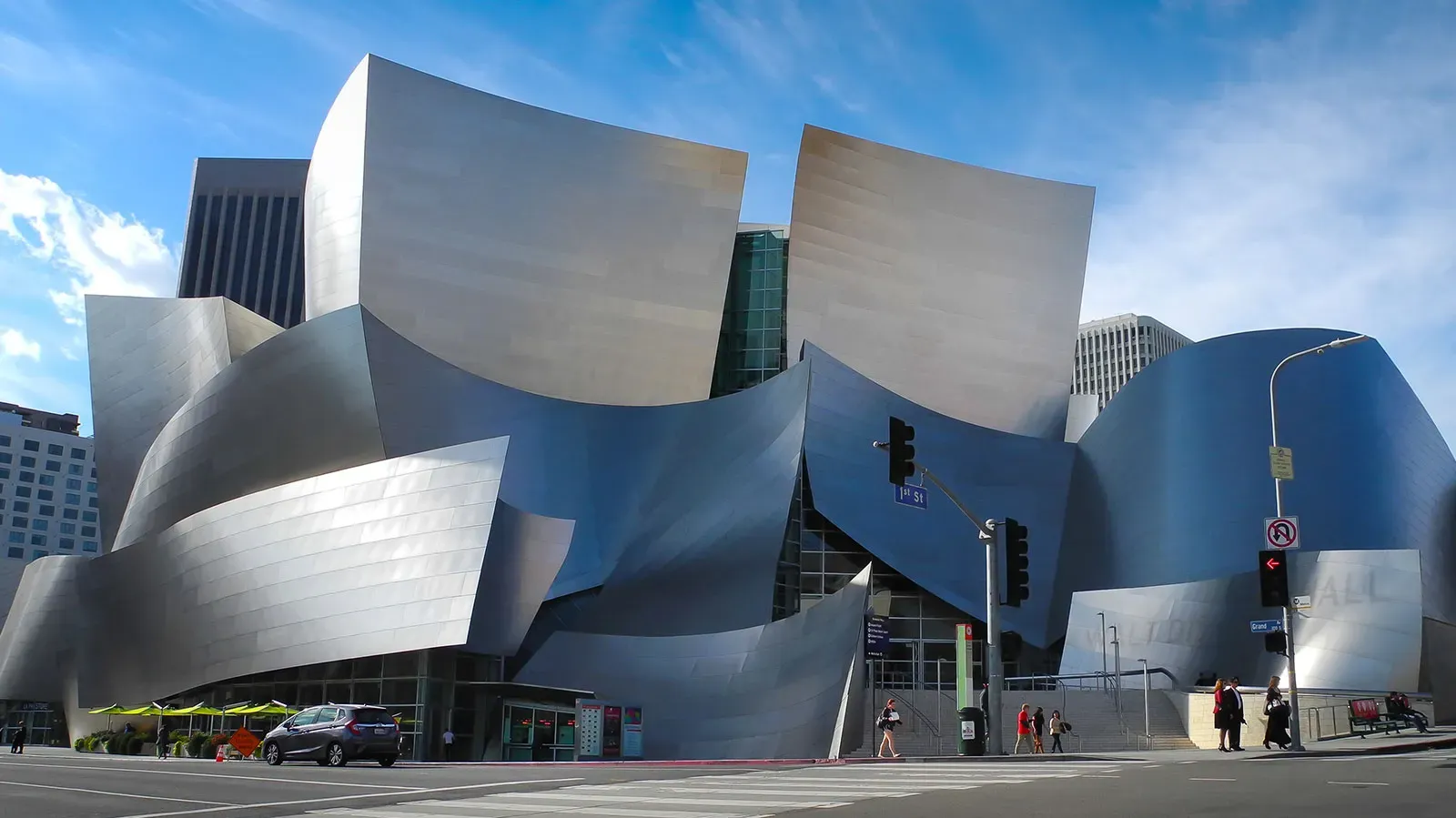
Following Bilbao, Gehry’s portfolio expanded rapidly across continents. His works include the Jay Pritzker Pavilion at Chicago’s Millennium Park, the Gehry Tower in Germany, the Louis Vuitton Foundation in Paris and the Walt Disney Concert Hall in Los Angeles. Each project reflected his unique ability to transform rigid structures into expressive, flowing forms.
Bernard Arnault, Chairman and CEO of LVMH, which owns Louis Vuitton, said of the Paris project:
“He bestowed upon Paris and upon France his greatest masterpiece.”
Among his most recognisable designs are Prague’s Dancing House, completed in 1996, which appears to fold and twist in motion, and his Hotel Marques in Spain, finished in 2006, featuring thin, multicoloured sheets of undulating metal. His business school design in Sydney, often likened to a crumpled brown paper bag, further demonstrated his refusal to conform to conventional aesthetics.
Technology, Criticism and Creative Defiance
Later in his career, Gehry embraced advanced 3D modelling technology originally developed for aerospace engineering. These digital tools allowed him to design complex, wind-swept structures that would previously have been impossible to construct. At the time, many architects avoided such techniques due to the extreme complexity and cost involved.
Not all of his projects escaped criticism. When the Walt Disney Concert Hall opened in 2003, some commentators described it as a “pile of broken crockery”, a “fortune cookie gone berserk” and an “emptied waste basket”. Gehry was unfazed. In a 2007 interview with The New Yorker, he responded simply:
“At least they’re looking!”
The Pritzker Prize and Industry Recognition
In 1989, at the age of 60, Gehry received architecture’s highest honour, the Pritzker Architecture Prize, recognising his lifetime contribution to the field. The jury described his work as possessing a “highly refined, sophisticated and adventurous aesthetic”.
“His designs, if compared to American music, could best be likened to Jazz, replete with improvisation and a lively unpredictable spirit,” the panel said at the time.
Cultural Influence Beyond Architecture
Gehry’s influence transcended architecture itself. The cultural impact of his work was even parodied in popular culture. In a 2005 episode of The Simpsons, the fictional town of Springfield invites Gehry—who voiced himself in the episode—to design a new concert hall. The shape of the hall was humorously inspired by a scrunched-up piece of paper.
The appearance later “haunted” Gehry, who told The Observer in 2011 that some people genuinely believed his real-life designs were inspired by crumpled paper rather than complex structural and digital engineering.
Tributes From Across the World
Tributes poured in from across the global design and political community following his passing. Paul Goldberger, author of Building Art: The Life and Work of Frank Gehry, described him as one of the rare architects who connected deeply with the public.
“He was one of the very few architects of our time to engage people emotionally,” Goldberger told BBC Radio 4’s The World Tonight.
“He was all about pushing the envelope… wanting to use the most advanced technology to do the most adventurous things.”
Canadian Prime Minister Mark Carney issued a statement expressing his “deepest condolences” to Gehry’s family and the “many admirers of his work,” adding:
“His unmistakable vision lives on in iconic buildings around the world.”
The Guggenheim Museum Bilbao also released a video tribute, writing on Instagram:
“We will be forever grateful, his spirit and legacy will always remain connected to Bilbao.”
An Enduring Architectural Legacy
Frank Gehry’s work changed the relationship between architecture, art and public space. His buildings challenged expectations, redefined materiality and proved that architecture could simultaneously provoke emotion, controversy and admiration. From cultural institutions and concert halls to commercial towers and private homes, his influence reshaped the language of global contemporary design.
As cities continue to evolve and embrace bold architectural statements as tools of identity and economic transformation, Gehry’s legacy will remain embedded in the very fabric of modern urban development.